Leadership Readiness: The Blind Spot in Transformation Success
We assess employees and organizations for change. Who assesses the leaders?
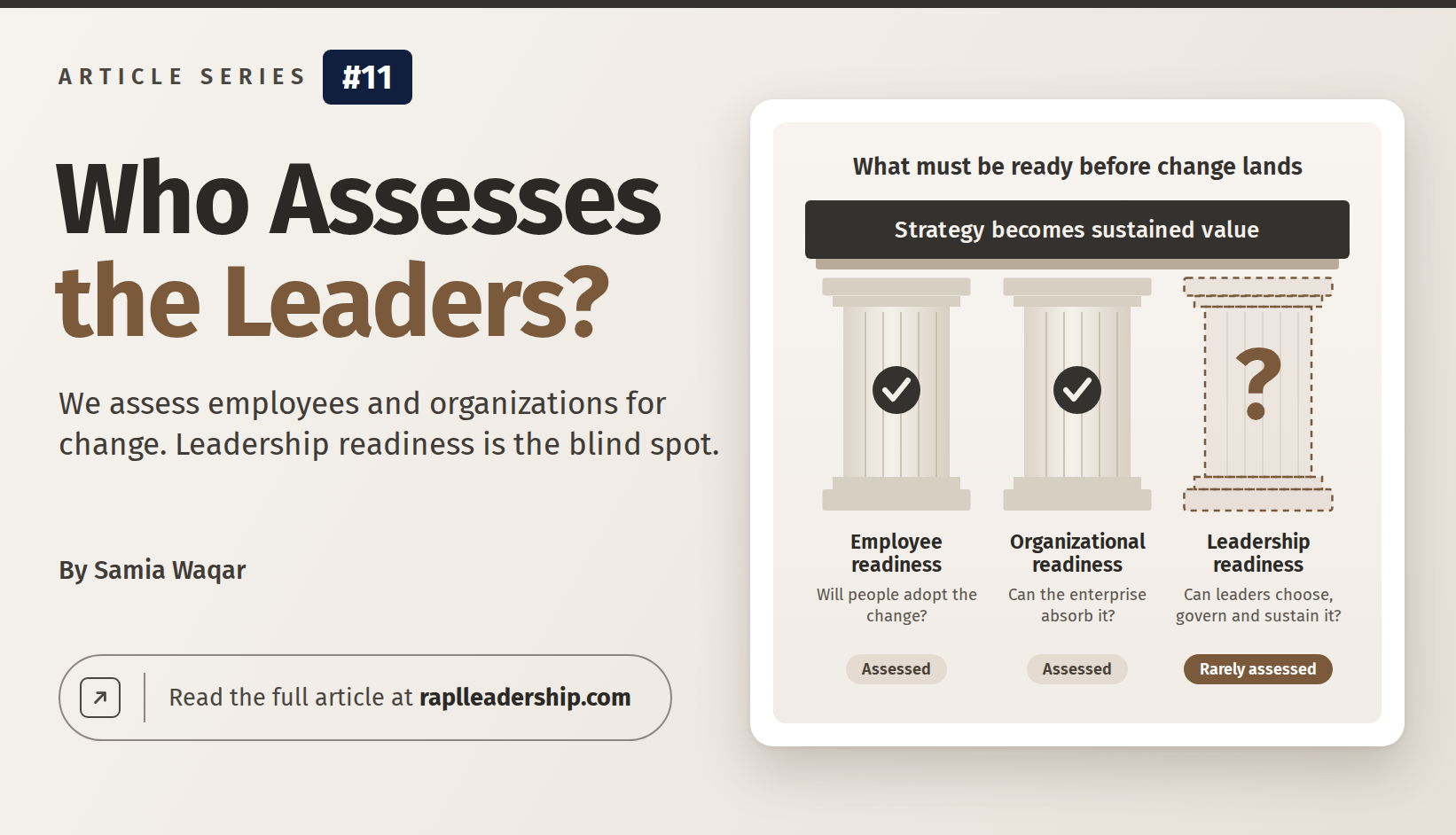
Companies routinely check whether employees and the organization are ready for change, yet rarely check whether the leaders sponsoring that change are ready. This article explains why leadership readiness is the deciding factor in strategy execution and how the RAPL™ framework turns it into something that can be assessed and developed.
Where the question came from
My career began in human resources a field where capability is never left to chance. It has to be defined, measured and built on purpose. We wrote job descriptions to spell out what a role should deliver, used job evaluation to gauge its complexity, authority and accountability, hired against set requirements, reviewed performance, identified capability gaps and prepared succession plans for positions with greater responsibility.
The logic was straightforward. Before asking whether a person is ready for a role, you must first be clear about what the role demands. A leadership capability gap should never surface only after someone is already sitting in a critical seat. The seat's requirements come first, the person's capabilities are measured against them and any real gap is closed before it puts people, performance or investment at risk.
Years later with nine PMI certifications, Prosci change management training and experience leading complex transformations in public and private organizations, I noticed that this logic was being applied unevenly. Organizations checked whether employees were prepared to adopt a change. They checked whether the enterprise had the culture, capacity, systems, governance and resources to absorb it. But they seldom checked whether the leaders who authorize, sponsor and govern the transformation were prepared to lead it.
That is not a small gap in a change plan. It is a strategic blind spot sitting exactly where the most consequential decisions are made. It led me to the idea of the Leadership Economy and to build the Role Agnostic Project Leadership™ (RAPL™) framework.
Why leadership readiness matters more than employee or organizational readiness
People often list employee readiness, organizational readiness and leadership readiness as three equal items. They depend on each other, but leadership readiness has a special place because leaders make the decisions that shape the other two.
Employees rarely authorize a transformation. They do not set its strategic priority approve its budget or define its risk appetite. They cannot settle enterprise-wide resource conflicts, change who holds decision rights or halt an initiative that no longer justifies its cost. The organization is not independent either: its readiness reflects leadership choices about structure, governance, capacity, technology, incentives and accountability.
Leaders hold the authority to set strategic intent approve investment, choose the work, allocate resources, appoint sponsors, design governance, resolve competing priorities, accept risk, redirect delivery and stop an initiative. They also decide whether the promised benefits will have named operational owners once implementation ends.
That makes leadership readiness the deciding pillar of transformation readiness. Employee readiness influences adoption. Organizational readiness influences absorption. Leadership readiness determines whether the right change is chosen, funded, governed and carried through to lasting value. When it is weak all the effort spent preparing employees and the organization can end up being excellent preparation for the wrong transformation.
A senior title is not proof of transformation readiness
Many organizations assume that a senior appointment is enough evidence that someone can lead transformation. Functional results, career progression and executive presence become stand-ins for capabilities nobody actually assessed.
A CFO can be an outstanding financial leader without ever having governed a complex transformation portfolio. A CHRO can understand people strategy deeply yet have limited experience tying adoption to benefits realization. A technology executive can know the solution well but lack the ability to question whether the business, the data and the operating environment are ready for it. A COO can excel at operational performance and still struggle to fit disruptive change into the existing operating model.
None of this says these leaders are ineffective. It says that running the business and transforming the business are related but different capability demands. A title shows that authority was assigned. It does not show that the capability required by a new kind of work has been built.
Commitment is not proof either. A sponsor may attend every meeting, voice support and clear visible obstacles, yet still be unable to challenge a weak business case, spot unrealistic benefits, read shifting risk exposure or make a needed stop decision. Commitment shows that a leader backs the transformation. Readiness shows whether the leader can make the decisions its value depends on. (For more on this distinction, see our article on the leadership capability gap.)
The work has changed faster than leadership development
The environment has expanded what leaders are responsible for. Artificial intelligence, technology disruption, talent and workforce shifts, market volatility, regulatory pressure and structural change are raising both the amount and the consequence of non-operational work.
Leaders must still run the organization, from operational performance and customer value to financial stewardship, workforce stability, compliance and service delivery. Now they must do all of it while continuously transforming the enterprise. Every leadership seat therefore carries two accountabilities at once: protect today's performance and build tomorrow's capability. We explore this tension in building the future vs. protecting the present.
Even a simple enterprise copilot rollout shows the scale of the shift. What looks like a technology implementation quickly raises questions of strategic purpose, data access, cybersecurity, privacy, intellectual property, workforce impact, human oversight, adoption, governance and return on investment. A technology team or project manager cannot own all of these alone. They need enterprise authority and cross-functional judgment. This is only the beginning: autonomous agents and intelligent systems that can decide and act across business processes have barely arrived. If leadership work changed this much in the last decade, it is unrealistic to expect the required capabilities to stay the same in the next. (Read more in leadership capability in the age of AI.)
Strategy execution depends on leadership decisions
Many organizations treat strategy creation as leadership work and execution as delivery work. That split creates a dangerous accountability gap. A strategy does not become executable just because it was approved. It has to be turned into a coherent portfolio of projects, programs, operating model changes and capability investments. Priorities must be balanced against capital and capacity, dependencies integrated, decision rights set and benefits defined, measured and given to operational owners.
These are all leadership decisions. A project manager can build the schedule but cannot decide which strategic initiative loses funding when capacity runs short. A portfolio professional can show that the organization is attempting too much but cannot force executives to trade off. A risk specialist can explain exposure but cannot set risk appetite. A change practitioner can spot resistance but cannot create alignment among leaders sending mixed messages. A program manager can map benefits but cannot assign accountability to an operational executive without senior authority.
Practitioners supply evidence, analysis and recommendations. Leaders must exercise judgment and decide. That is why the quality of strategy execution cannot be separated from leadership readiness: the people who authorize, fund, pause, redirect and stop the work are the same people whose capability most affects whether strategic intent survives its journey into operations. See our deeper look at the strategy execution gap and the leadership integration gap.
From the Project Economy to the Leadership Economy
Antonio Nieto Rodríguez has done important work in advancing the global conversation on the Project Economy, showing how project-based work is moving to the center of value creation. The consequence for leaders is significant.
Operations deliver and protect the value an organization creates today. Projects, programs and transformation initiatives increasingly build the capabilities through which it plans to create value tomorrow. As organizations become more project-driven, AI-enabled and transformation-intensive, project leadership can no longer live only inside the project profession.
The Project Economy changes what leaders must lead. The Leadership Economy asks whether leaders are capable of leading it. It describes an environment in which leadership capability becomes a strategic asset, because more and more organizational value depends on decisions made across complex transformation work. Competitive advantage lies not only in the technology a company buys or the strategy it announces, but in its leaders' ability to convert strategic intent into lasting operational value. This is the argument I develop through the Leadership Economy and put into practice through RAPL™. You can browse the supporting evidence on our research page.
A personal lesson: I assumed I was ready
My nine PMI certifications gave me grounding in the disciplines needed to lead projects, programs, portfolios, risk, agile work, business analysis, execution offices, AI initiatives and responsible value. Prosci deepened my understanding of sponsorship, individual readiness, resistance, adoption and reinforcement. My HR background showed me how organizations turn capability into job design, hiring, development, performance management and succession. (Here is how PMI capabilities apply to leaders, not just practitioners.)
My transformation work then showed me what happens when these disciplines meet organizational reality. Practitioners were expected to learn, demonstrate and apply the capabilities. The leaders governing their work were not always expected to understand those disciplines well enough to make sound strategic decisions. The people doing the work were being prepared. The people authorizing and governing it were often just assumed to be ready.
That gap became personal when I started building an AI application. I had deep transformation experience, strong business knowledge and plenty of confidence. I rushed toward building the solution before properly validating the business problem and checking whether my data could deliver the intended result. I had data, but not AI-ready data. I had never set a genuine decision point based on business fit, data readiness, strategic risk, cost and expected return. By the time the weaknesses were obvious, significant time and money were already spent. I had optimized delivery before proving viability.
On the next initiative, I reversed the order. I started with the business need, tested the assumptions, examined the evidence, assessed data readiness and set clear decision gates before authorizing major development. The second effort cost roughly one fifth of the first. In my case, close to 80 percent of the earlier spend could likely have been avoided with stronger decisions at the start.
The key lesson was not technical. It was about leadership readiness: powerful technology does not fix a weak leadership decision. It scales that decision faster, wider and at far greater cost.
Testing the pattern beyond my own experience
I did not want to build a leadership framework on one story, so I discussed the problem with executives, transformation leaders, project professionals and change practitioners to see whether they saw the same gap. The same conditions kept coming up. Organizations approved more transformation than they had capacity to support. Too many priorities were greenlit without real trade-offs. Initiatives looked justified one by one while collectively overwhelming the organization. Governance forums reviewed mountains of information without turning it into timely decisions. Sponsors were supportive but often unavailable when teams needed decisions only executive authority could make. Successful implementation did not reliably lead to adoption, benefits or sustained value.
Many problems blamed on delivery teams were created or prolonged by capability gaps above them. The PMO was not always the problem. The methodology was not always the problem. The project manager was not always the problem. Sometimes the missing capability sat with the leaders who had the authority to choose, govern and stop the work. (This is explored further in the delivery capability gap.)
What is the Leadership Capability Gap?
I define the Leadership Capability Gap as the difference between the capability an organization's transformation agenda demands and the capability its leadership system has deliberately defined, developed and can demonstrate.
This is usually not a personal failing of individual leaders. It is more often a structural weakness in the leadership system. Organizations cannot fairly expect leaders to show capabilities that were never written into their job descriptions, assessed in hiring, developed in leadership programs, measured in performance reviews or considered in succession planning. The environment has changed the work, but the internal leadership system has not always turned that change into updated capability requirements, which puts strategy execution, investment performance and organizational value at risk. If the work has changed, the leadership seat must be redefined. Read the full framing in Leadership Capability Gap and RAPL™.
How Role Agnostic Project Leadership™ makes readiness visible
I created the RAPL™ Enablement Framework to make leadership readiness visible, assessable and developable. Its core idea is that project leadership is no longer limited to a project role. It is a leadership capability needed wherever accountability for transformation sits. "Role agnostic" does not mean every leader needs the same level of proficiency. It means these capabilities may be needed in any leadership role, because transformation accountability now cuts across functions, titles and levels.
RAPL™ looks at four connected layers:
- Context Layer: the external and internal conditions changing the work.
- Leadership Capability Gap Layer: the demands of the seat compared with the capability that can currently be demonstrated.
- Capability Engine Layer: how required capabilities are assessed, developed, applied, evidenced and refreshed.
- Outcome Layer: whether strategic intent becomes responsible, sustained operational value.
Within this structure, leadership accountability falls into four phases and twelve capabilities:
- Define the Work: Diagnose, Choose, Translate. Leaders diagnose the real business need, make explicit strategic choices and turn intent into executable work.
- Govern the Work: Select, Integrate, Deliver. Leaders pick the initiatives worth continued investment, integrate dependencies and create the conditions for delivery.
- Protect the Work: Protect, Align, Govern. Leaders link uncertainty to value at risk, keep stakeholders aligned and build governance that surfaces early truth and enables timely decisions.
- Land the Value: Optimize, Adopt, Sustain. Leaders optimize the opportunity, embed change in everyday work and sustain benefits after go-live.
The leader does not need to do the practitioner's specialist work. The leader must understand it well enough to commission it, challenge the evidence and make the decisions that cannot be delegated. For a practical view, see modern initiative leadership.
Readiness has to be demonstrated continuously
Transformation rarely follows a predictable path. Evidence shifts, risks emerge, stakeholder commitment changes and new technology opens new options. An initiative that deserved funding six months ago may no longer meet today's investment criteria.
For this reason RAPL™ uses five adaptive modes that leaders return to again and again: Sense what is really happening, Prioritize what matters and what must be refused, Mobilize the conditions for execution, Steward through evidence and decision authority and Adapt when strategy, portfolio or operating approach must change.
Leadership readiness therefore cannot be confirmed by one training program or a static assessment. It has to be shown through real decisions and refreshed as the work evolves. The RAPL™ organizational capability cycle is continuous: Assess, Develop, Apply, Evidence, Refresh and it loops back to assessment because the capability a seat requires keeps changing with strategy, technology, risk and the external environment.
Building leadership readiness into the talent system
This brings the argument back to where my career started. If transformation is part of every leader's job, transformation capability must become part of every leadership decision. Leadership readiness belongs in job descriptions, job evaluation, hiring, promotion, succession planning, performance management, sponsor selection, executive development and leadership rewards. Before naming a leader to sponsor a major transformation, define what the accountability requires and check whether that person can demonstrate the necessary capability.
The assessment should start with the seat, not the reputation of whoever sits in it. Ask: What strategic work will this role authorize? Which investments will it govern? How much uncertainty will it carry? Which decisions cannot be delegated? What benefits will it own? What value is at risk if the leader is not ready?
Different seats need different depth. A CHRO may need more depth in workforce transformation, stakeholder alignment, adoption and the human consequences of AI. A CFO may need more depth in investment selection, resource allocation, benefits realization and stop decisions. A CIO or CTO may need more depth in data readiness, responsible technology governance and operationalization. A COO may need more depth in integration, operating model change, adoption and sustained performance. A CEO must bring these perspectives together and make sure the whole leadership team can turn strategy into enterprise value. The depth changes by seat. The need for a shared leadership language does not.
To see how this works in practice, take the RAPL™ Leadership Readiness Diagnostic, or explore our solutions for organizations.
The blind spot organizations can no longer afford
Employee readiness, organizational readiness and leadership readiness are distinct but interdependent. Employees must be ready to adopt the change. The organization must be ready to absorb it. Leaders must be ready to select, authorize, govern, protect and sustain it.
Without employee readiness, change may be resisted. Without organizational readiness, it may exceed the institution's capacity. Without leadership readiness, the organization may fund the wrong work, back an unviable solution, dodge necessary trade-offs and discover too late that a successful implementation created no meaningful value. Leadership readiness is not just another item on a change management checklist. It is the deciding condition for whether strategy becomes the right work and whether that work reaches sustained value.
Technology creates possibility. Leadership determines whether that possibility becomes value. RAPL™ does not ask every leader to become a project manager. It asks every organization to stop assuming its leaders are ready for project-driven, AI-enabled, transformation-intensive work just because they hold leadership positions.
We assess employees for change. We assess organizations for readiness. It is time to assess leaders for the work only they have the authority to lead. Because the greatest risk to transformation may not be the capability missing from the project team. It may be the capability we assumed was already present at the top.
Continue exploring: The RAPL™ Framework · Leadership Readiness Diagnostic · Research · Resources · Podcasts
Frequently Asked Questions
1. What is leadership readiness?
Leadership readiness is the degree to which leaders can demonstrate the capability required by their specific seat to select, authorize, govern, protect and sustain transformation. It is based on what the role demands, not on title, tenure or reputation.
2. How is leadership readiness different from employee and organizational readiness?
Employee readiness concerns whether people will adopt a change, and organizational readiness concerns whether the enterprise can absorb it. Leadership readiness concerns whether the right change is chosen, funded, governed and carried into lasting value. Leaders control the decisions that shape the other two, which is why it is the deciding pillar.
3. Why isn't leadership commitment enough?
Commitment shows that a leader supports a transformation. It does not show that the leader can challenge a weak business case, recognize unrealistic benefits, interpret changing risk or make a hard stop decision. Readiness is proven by the quality of decisions, not by visible support.
4. What is the Leadership Capability Gap?
It is the difference between the capability an organization's transformation agenda demands and the capability its leadership system has deliberately defined, developed and can demonstrate. It is usually a structural weakness in the leadership system rather than a personal failure. Read more in our Leadership Capability Gap article.
5. What is Role Agnostic Project Leadership™ (RAPL™)?
RAPL™ is an enablement framework built on the idea that project leadership is a capability required wherever transformation accountability sits, not just in project roles. It defines four phases, twelve capabilities and a continuous cycle of Assess, Develop, Apply, Evidence and Refresh. Explore the framework.
6. Does every leader need to become a project manager?
No. Leaders do not need to perform specialist practitioner work. They need to understand it well enough to commission it, challenge the evidence and make the decisions that cannot be delegated. The required depth differs by seat.
7. How can an organization assess leadership readiness?
Start with the seat: what strategic work, investments, uncertainty, non-delegable decisions and benefits it carries. Then compare that with the capability the leader can demonstrate and build the result into hiring, promotion, succession, performance management and development. You can begin with the Leadership Readiness Diagnostic.