Leadership Hasn't Kept Pace With the Work It's Meant to Govern
How Role Agnostic Project Leadership™ (RAPL™) closes the gap between strategic intent and sustained operational value
Why converting strategy into results now demands a different kind of leadership capability and how Role Agnostic Project Leadership™ (RAPL™) closes that gap
Most organizations have spent years perfecting how they run the business operating models, performance systems, governance structures, leadership pipelines. These systems still matter. But the kind of work leaders are now accountable for has shifted faster than the systems built to prepare them for it.
A growing share of enterprise value no longer comes purely from operations it comes from the work of changing the organization: transformation, digital modernization, portfolio investment, new operating models, AI adoption, restructuring and innovation. As automation and AI absorb more routine operational work, leadership attention is pulled toward initiatives that are cross-functional, time-bound, uncertain and dependent on coordinated change across the enterprise. Operational excellence hasn't become irrelevant it has become insufficient on its own.
This is why organizations can have strong executives, technically sound teams and a credible strategy on paper and still fail to turn that strategy into sustained results. The root cause is rarely the strategy itself or the competence of the delivery team. It's a quieter, more structural question: has the organization deliberately built the leadership capability required to govern this kind of work?
You can explore the full case behind this question on the RAPL framework page.
Naming the Gap: What RAPL Calls the Leadership Capability Gap
RAPL™ defines the Leadership Capability Gap as the distance between the strategic work an organization must deliver and the leadership capability it has actually and deliberately assessed, built, evidenced and deployed to lead that work.
This is a structural gap not a personal shortfall. Leaders are typically promoted on the strength of functional expertise, operational performance and sound judgment within a known domain. The same leader is then asked to sponsor a transformation, govern a portfolio, make investment trade-offs across competing initiatives, oversee AI adoption or protect benefits that are at risk work that draws on a different capability set entirely.
Experience in one environment doesn't automatically transfer as capability in another. Leadership development research has consistently shown that experience only becomes developmental when it's paired with challenge, feedback, reflection and transfer not simply accumulated over time (DeRue and Wellman, 2009; Dragoni et al., 2009). RAPL applies that same logic at the enterprise level: capability should be defined by the demands of the work itself, not assumed from seniority or past functional success.
A deeper breakdown of this gap and why it stays invisible until execution begins is covered in Understanding the Leadership Capability Gap.
What RAPL Actually Is
Role Agnostic Project Leadership™ (RAPL™) is a Leadership Capability Enablement Framework built to convert strategic intent into sustained operational value across project-shaped, transformation-heavy and AI-enabled work regardless of a leader's functional title.
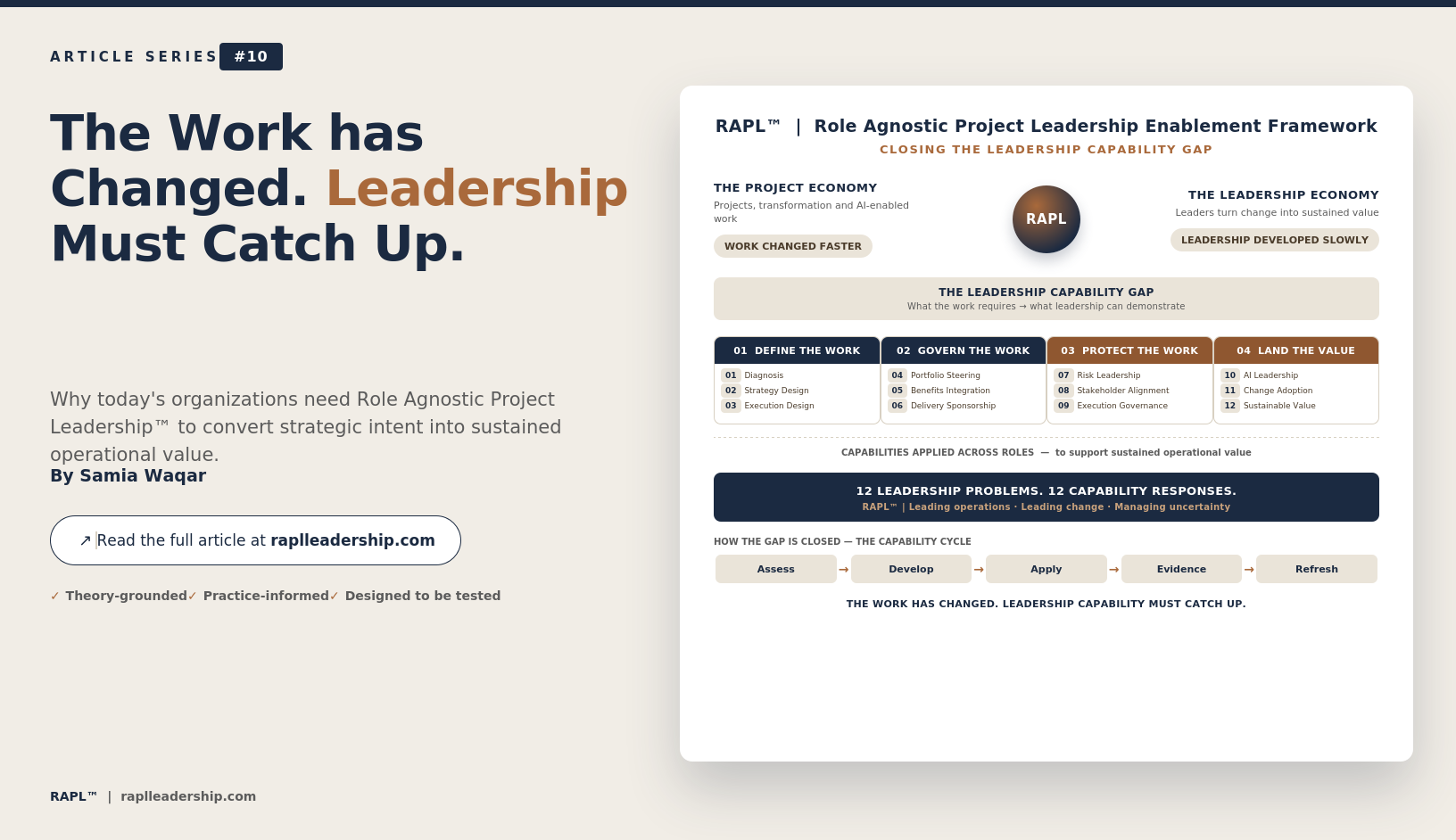
RAPL connects four elements into one system: the external pressures organizations face, how the organization responds, how leadership capability is aligned to that response and an ongoing cycle that keeps capability current. At its center sits one purpose turning intent into value that actually lasts.
At the executive level this means knowing what to commission, question, decide, govern, develop and reward without stepping into the practitioner's seat. At the practitioner level, it means being able to build, defend, apply and evidence the capability that those executive decisions rely on.
This distinction matters. The practitioner builds the diagnosis, assesses risk, develops portfolio evidence, maps benefits, designs the adoption plan or runs the delivery system. The senior leader doesn't duplicate that work the leader sets the standard, commissions it, interrogates the evidence, makes the call and governs the conditions the work depends on to succeed.
One Framework, One Point Where Value Crosses Over
RAPL isn't a linear delivery methodology it's a leadership system built around a single value crossing, surrounded by four interconnected phases:
- Define the Work — Strategic Diagnosis, Strategy Design, Execution Design
- Govern the Work — Portfolio Steering, Benefits Integration, Delivery Sponsorship
- Protect the Work — Risk Leadership, Stakeholder Alignment, Execution Governance
- Land the Value — AI Leadership, Change Adoption, Sustainable Value
These twelve capabilities aren't a checklist to move through in order. They're recurring leadership demands that combine differently depending on the role, the initiative and the moment. Deciding whether an AI pilot is ready to scale, for instance, can require diagnosis, risk review, stakeholder alignment, adoption planning, operational ownership and a judgment call on whether the value will actually hold often all at once.
The execution and governance side of this is explored further in Closing the Delivery Capability Gap.
Capability Doesn't Sit in a Vacuum — the Environment Is Part of the Framework
RAPL places leadership capability inside both an internal and external environment. Workforce shifts, structural change, AI disruption and market volatility are constantly reshaping the work leaders are asked to govern. That environment is dynamic, interconnected and often unpredictable which means capability has to be aligned to it continuously not set once and left alone.
This is why RAPL treats capability as a cycle, not a fixed state: Assess, Develop, Apply, Evidence, Refresh. Capability is measured against what the role actually demands, deliberately built, tested in live work, evidenced through real behavior and refreshed as the strategic agenda shifts.
The point was never attendance at a leadership program. The point is whether development changes the quality of real decisions which is what separates leadership development from leadership capability enablement.
Same Capability Title, Different Depth by Seat
Role-agnostic doesn't mean role-identical. A CEO, CFO, CIO, CHRO, COO, transformation executive, portfolio leader and business-unit leader may all need RAPL capability but not at the same depth in every domain. RAPL works as a role-demand model: the real question is whether the person in a given seat has the depth of capability that the frequency and consequence of that seat's decisions actually require.
A CFO typically needs deeper capability in portfolio investment, benefits realization and stop-decisions. A CHRO needs more depth in leadership development, stakeholder alignment and workforce adoption. A CIO needs stronger capability in AI governance data readiness and operationalization. The CEO's job is to understand how these capabilities interlock across the senior team so the strategy isn't quietly depending on a gap nobody sees until execution starts.
See how this plays out in practice in Where Strategy Breaks Down Before Execution.
Why AI Makes This Gap Impossible to Ignore
AI is a useful stress test because it exposes the gap between technical success and organizational value. A model can work perfectly and still fail to create meaningful value if the organization hasn't addressed business need, data readiness, decision accountability, governance, stakeholder trust, workflow redesign, adoption and sustained monitoring.
Research on AI adoption shows that moving from experimentation to scale depends on organizational factors well beyond the technology itself (Ameye, Bughin and van Zeebroeck, 2025). Professional guidance echoes this placing strategic value, governance, risk, culture and human oversight alongside the technical side of AI initiatives (Project Management Institute, 2025b; 2026).
RAPL turns this into executive behavior. Leaders don't need to select algorithms or build models. They need to know what evidence has to exist before investing, what governance questions need answers before scaling, who owns the operational benefit, which risks require their intervention, and what conditions have to stay in place after deployment for the value to actually last.
AI doesn't replace the leadership problem it makes it visible. This is explored in more depth in Leadership Capability in the Age of AI and What PMI's Standards Mean for Leaders, Not Just Practitioners.
From Leadership Development to Capability Enablement
The core implication: capability shouldn't be assumed to emerge naturally from experience. It has to be made visible defined against the actual work, matched to the seat, deliberately built, applied under real conditions, evidenced through behavior, and reinforced by the systems that decide who gets selected, promoted, rewarded and trusted with governance.
This is also why RAPL isn't a replacement for established professional disciplines. Project management, program management, portfolio management, risk, business analysis, change management, benefits realization, PMO and AI disciplines still carry the deep practitioner knowledge. RAPL changes the level of analysis translating that domain expertise into the leadership behavior needed at the point where accountability, judgment and authority actually meet.
The Question Every Board Should Be Asking
The real question isn't whether an organization has a strategy. It's whether it has deliberately built the leadership capability needed to carry that strategy into results that last especially while trying to run the business and transform it at the same time.
RAPL doesn't claim every transformation failure is a leadership failure, and it doesn't claim credentials automatically create executive capability. Nor is the full RAPL framework being presented as empirically validated in its entirety it's intentionally evidence-aware, combining primary research, established literature, professional standards and practitioner experience, while keeping a clear line between evidence that supports the problem and validation of the complete architecture.
That honesty is what makes the case stronger. The Leadership Capability Gap can be measured. Role demands can be specified. Capability can be assessed, tested against real behavior and refined as stronger evidence emerges. You can review the evidence base behind this on the RAPL research page.
For boards and executive teams, the practical test is simple: if your strategy were approved today, could you prove the leaders accountable for it have been deliberately prepared for the work it demands?
FAQs
What is Role Agnostic Project Leadership (RAPL)?
RAPL is a Leadership Capability Enablement Framework designed to help leaders convert strategic intent into sustained operational value across transformation, AI-enabled and project-shaped work regardless of their functional title.
What is the Leadership Capability Gap?
It's the distance between the strategic work an organization must deliver and the leadership capability it has deliberately assessed, developed and deployed to lead that work. Read more on the Leadership Capability Gap page.
How is RAPL different from traditional leadership development programs?
Traditional programs often build general competencies. RAPL ties capability directly to the demands of a specific seat and specific strategic work, then runs it through an ongoing Assess–Develop–Apply–Evidence–Refresh cycle rather than a one-time training event.
Does RAPL replace project management, PMO or change management disciplines?
No. RAPL doesn't replace these disciplines — it translates their relevant expertise into leadership behavior at the executive level, where accountability, judgment and authority intersect.
Why does AI make the Leadership Capability Gap more visible?
Because a technically successful AI model can still fail to create value without the right business need, data readiness, governance, adoption planning and executive oversight. AI exposes gaps that were previously easy to overlook.
Who needs RAPL capability — only project managers?
No. RAPL is role-agnostic by design. CEOs, CFOs, CIOs, CHROs, COOs, transformation executives and portfolio leaders all need it, though the required depth differs by seat and decision consequence.
Is RAPL an empirically validated framework?
Not in its complete form yet. RAPL is intentionally evidence-aware it draws on established research, professional standards and practitioner experience while being transparent about where evidence supports the underlying problem versus where the complete framework still needs further validation.
Explore more: The RAPL Framework · Research Behind RAPL · Take the Diagnostic · Certification · About Samia Waqar