The Project Economy Has Created a Leadership Capability Gap — Not Just a Talent Gap
Why the Project Economy's shift toward change-driven work demands a new kind of leadership and why certifications alone won't close the gap.
What an Amazon facility launch taught me about People, Technology and the future of leadership
The way enterprise value gets created has fundamentally changed. A growing share of it no longer comes from running stable operations it comes from change itself: digital transformation, AI adoption, portfolio decisions, new operating models, customer experience redesign, regulatory shifts and cross-functional strategic initiatives.
This is the real shift underway. Organizations have moved from primarily running the present to continuously building the future yet leadership development has not caught up. Leaders are still largely trained for operational excellence, then handed responsibility for sponsoring, governing, prioritizing, and sustaining project-shaped work they were never developed to lead.
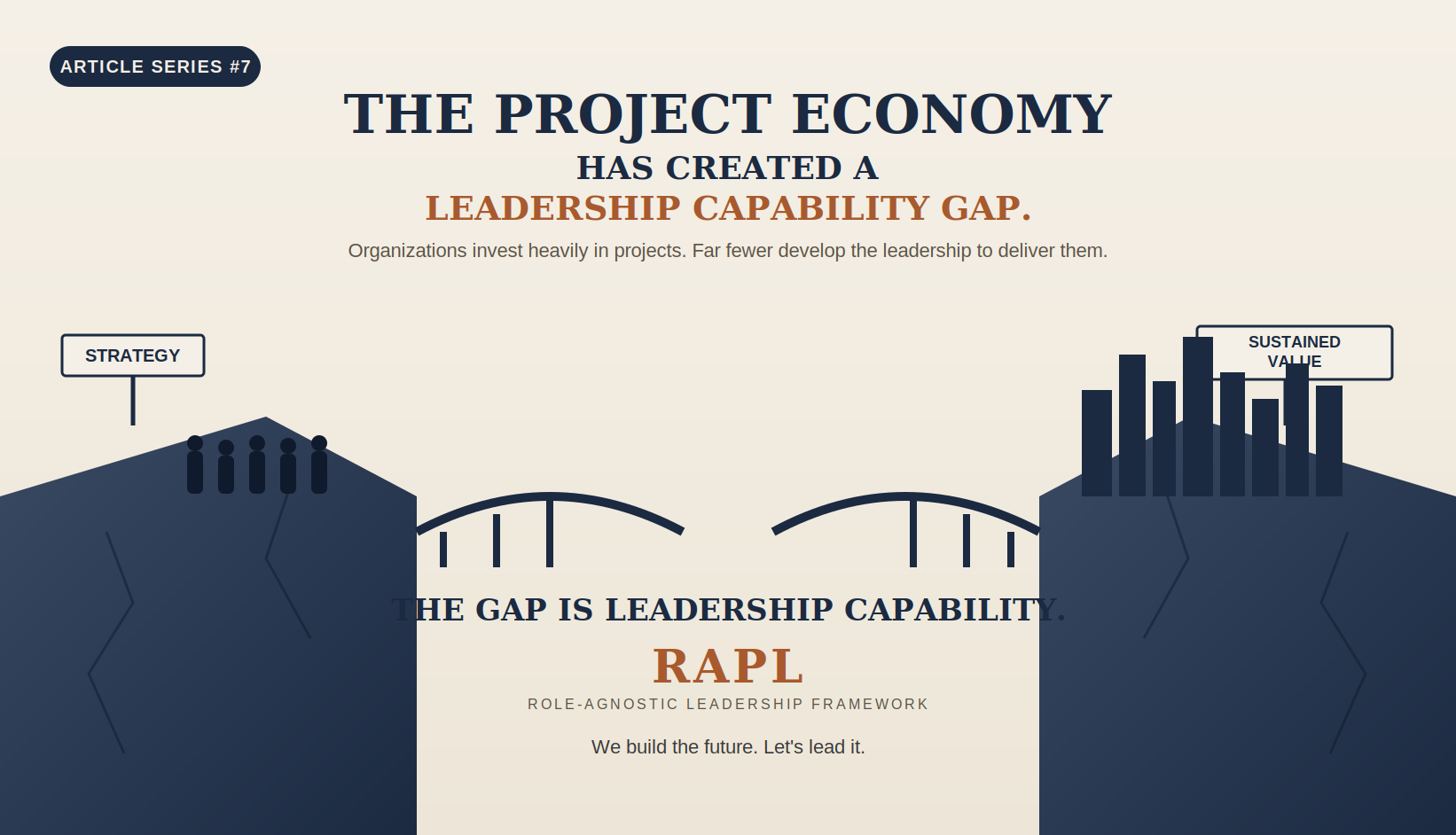
That mismatch is the heart of the problem. It isn't simply a talent shortage, and it isn't only a project management shortfall. It is a leadership capability gap and it's exactly the kind of gap our leadership framework was built to address.
What Happens When the Work Changes but Leadership Doesn't?
Sometimes a shift in vocabulary tells you the work itself has changed. I saw this firsthand during my time at Amazon as the language around the people function evolved toward People eXperience and Technology. I was also part of the team supporting the launch of Amazon's Ottawa facility an experience that gave me a hands-on education in something I didn't yet have words for.
A facility launch isn't just an operations event, an HR event, or a technology rollout. It's project-shaped work in its purest form: hiring, onboarding, training, safety, leadership readiness, scheduling, communication, escalation paths, technology adoption and employee experience all converging under pressure. The building opens on schedule, but what actually launches is a human operating system.
That experience taught me something I still apply today: people capability, employee experience, operational readiness and technology adoption aren't separate workstreams. In project-driven environments, they collapse into one system. That's why People eXperience and Technology always struck me as more than a rebrand:
- People — because capability, trust, and leadership determine whether an organization can actually absorb change.
- Experience — because employees don't experience transformation through strategy decks; they experience it through workflows, tools, managers and the daily friction or confidence those create.
- Technology — because work today is mediated, accelerated and increasingly redesigned by digital systems and artificial intelligence.
The future of HR isn't just a people process. It's an enterprise capability.
Why a LinkedIn Post About AWS Certifications Made Me Pause
Beth Galetti's LinkedIn announcement that Amazon would cover one AWS AI/Machine Learning certification exam per year for every employee is worth more attention than it might first appear.
Read at face value, it's an upskilling perk. Read strategically, it's a signal: AI literacy is no longer being treated as a niche technical skill reserved for specialists. It's becoming part of the everyday operating vocabulary of the entire workforce.
But here's the distinction that matters most: a certification builds access to knowledge — it doesn't automatically build capability.
Real capability shows up when learning actually changes decisions when a leader can ask:
- Is this AI use case solving the right business problem?
- Is the underlying data actually ready?
- Has the workflow been redesigned around the new tool, or just layered on top of the old one?
- Has adoption been planned or just announced?
- Is risk being governed or ignored until it becomes a headline?
- Is ownership clear?
- Is value being measured after launch not just assumed at go-live?
Training opens the door. Capability is what walks through it. This is precisely the gap our organizational diagnostic is designed to surface before it becomes a costly, visible failure.
The Scale of the Shift Isn't Up for Debate
The data backs this up. Writing in Harvard Business Review, Antonio Nieto-Rodriguez cited Project Management Institute estimates that project-oriented economic activity worldwide would grow from $12 trillion in 2017 to $20 trillion by 2027 pulling roughly 88 million people into project-oriented roles. He also pointed to a quieter but more telling inversion: a generation ago, about 80% of organizational resources supported operations and 20% supported projects. Today that ratio has effectively flipped.
Value is now created primarily through change.
And yet results haven't kept pace with the investment. The same research cites Standish Group data showing that only around 35% of projects worldwide actually succeed.
The easy conclusion is that organizations have a project management problem one that better tools, methods or certifications can fix. That conclusion isn't wrong. It's just incomplete. And the incomplete part is where the real gap is hiding.
The Real Gap Sits Above the Project Manager
Most leaders are selected and promoted for operational excellence: running a function smoothly, hitting recurring targets, managing stable teams, controlling cost, delivering predictable performance.
Then they're asked to sponsor transformations, govern portfolios, arbitrate competing priorities, lead AI adoption, protect the value of major investments and convert strategy into realized outcomes.
These are fundamentally different activities. They demand different judgment. They require different forms of accountability. Yet very few leaders are deliberately developed for them.
This is the leadership capability gap — the distance between the leadership that project-driven, AI-enabled work now demands and the leadership capability organizations have actually assessed, developed, embedded and rewarded.
So here's the uncomfortable question worth sitting with: are we promoting leaders for how well they ran the present, then asking them to build the future without ever developing the capabilities future-building requires?
This Isn't a Talent Problem — It's a Developmental One
The leaders facing this gap are usually intelligent, committed and experienced. The deficit isn't in who they are it's in what they were never deliberately developed to do because operational mastery and change leadership draw on genuinely different disciplines.
The research bears this out consistently:
- Kaplan and Norton traced the recurring failure of sound strategies not to poor design, but to weak execution systems meant to deliver them.
- Rumelt argued that strategy is fundamentally an act of choice including the discipline of deciding what not to do.
- Teece, Pisano, and Shuen described dynamic capability as an organization's capacity to sense change and reconfigure itself in response.
- Kotter's research on failed transformations reached a similar conclusion from a different angle: the recurring causes weren't technical execution failures, but leadership failures weak urgency, weak coalitions, unclear vision and premature declarations of victory.
None of these capabilities develop automatically just because someone manages operations well. Each one has to be built intentionally which is exactly the thinking behind our leadership certification programs.
AI Is Widening the Gap, Not Closing It
As automation absorbs more transactional, administrative and analytical work, the distinctly human contribution shifts upward toward judgment, prioritization, governance, stakeholder alignment, responsible adoption and the translation of strategy into outcomes.
These are leadership capabilities. And an organization that hasn't deliberately developed them can't simply buy them, assume them from tenure, infer them from confidence or outsource them entirely to project professionals, data scientists, consultants or software vendors.
This is where Beth Galetti's post really lands. Not because one certification benefit solves the leadership capability gap on its own it doesn't. But because it signals the conversation moving in the right direction: people, learning, technology and future-readiness are no longer separate leadership conversations. They're the same conversation.
If AI learning is treated purely as a training line item an organization may increase knowledge without increasing capability. If it's treated as part of a broader capability system, the question changes from how many people completed the course? to what can this organization now do that it couldn't do before?
That question is the real capability test.
The Questions That Actually Matter
- Can employees identify genuinely better AI opportunities not just more of them?
- Can leaders govern risk with real judgment, not just checklists?
- Can teams redesign workflows around new tools, rather than bolting tools onto old workflows?
- Can sponsors tell the difference between technical success and actual business value?
- Can operational leaders build genuine adoption, rather than simply announcing deployment?
- Can the enterprise sustain benefits after the initiative officially closes?
These aren't questions about training activity. They're questions about applied leadership capability and they determine whether AI becomes a source of durable value or just another wave of impressive pilots, disconnected tools and unrealized promises. Our organizational research digs into exactly this pattern across industries.
Why the Label Matters
The Project Economy didn't create only a project management gap one that's solvable with more practitioners and better tooling. It created a leadership capability gap and the two demand different responses.
Project management is a matter of delivery mechanics. Leadership capability is a matter of how organizations develop the people who sponsor, govern, prioritize, adopt and sustain change regardless of what title sits on their door.
Much of what's needed to close this gap already exists, scattered across established project, program, portfolio, risk, governance, business analysis, agile, change management, PMO and AI delivery disciplines. The problem isn't that these capabilities are missing. It's that they're rarely developed as one integrated leadership system and rarely even recognized as leadership at all.
This is the exact gap we help organizations close not through another isolated course, but through an integrated capability-building approach.
A Question Worth Asking Inside Your Own Organization
In your organization is AI capability being treated as a training problem solvable with more courses and certifications or as a leadership problem, solvable by deliberately developing the people who sponsor, govern, adopt and sustain the work?
And more broadly: has your leadership system caught up with the Project Economy or is it still preparing leaders for a world where value came mainly from running stable operations?
The honest answer tends to reveal exactly how wide the gap has quietly become. If you'd like a clearer picture of where your organization stands, explore our diagnostic tool or browse our resources for practical starting points. To learn more about our approach visit our about page.
Frequently Asked Questions
What is the leadership capability gap?
The leadership capability gap is the distance between the leadership skills that project-driven, AI-enabled work now demands judgment, governance, prioritization and change leadership and the leadership capability organizations have actually developed, assessed, and rewarded. Most leaders are still trained for operational excellence rather than for leading change.
Is the leadership capability gap the same as a project management gap?
No. A project management gap is about delivery mechanics tools, methods and practitioner skills. A leadership capability gap sits above that: it's about whether the people sponsoring, governing and adopting change have been deliberately developed to do so. Fixing one doesn't automatically fix the other.
Why is AI making the leadership capability gap worse?
As AI takes over more transactional and analytical tasks, the value of human leadership shifts toward judgment, prioritization, stakeholder alignment and responsible adoption. These are leadership skills, not technical ones and they can't be purchased, assumed from tenure or outsourced to vendors and consultants.
Does a certification like an AI/ML exam close the leadership capability gap?
Not on its own. A certification builds access to knowledge and a shared vocabulary, but capability only shows up when that learning changes real decisions how risk is governed, how workflows are redesigned and how value is measured after launch, not just assumed at go-live.
How can organizations start closing their leadership capability gap?
The first step is usually an honest diagnostic of where leadership development has focused on operational excellence versus change leadership. From there organizations need an integrated capability-building approach not isolated training that develops the people who sponsor, govern, prioritize and sustain project-shaped work.
This article is part of an ongoing leadership research series exploring how the Project Economy is reshaping what organizations need from their leaders. Explore the full leadership framework or get in touch to learn how we help organizations close this gap.
References
Galetti, B. LinkedIn post on Amazon supporting AWS AI and Machine Learning certification access for employees. Kaplan, R. S. and Norton, D. P. (2008) The Execution Premium: Linking Strategy to Operations for Competitive Advantage. Boston: Harvard Business Press. Kotter, J. P. (1995) 'Leading Change: Why Transformation Efforts Fail', Harvard Business Review, 73(2), pp. 59–67. Nieto-Rodriguez, A. (2021) 'The Project Economy Has Arrived', Harvard Business Review, 99(6), pp. 38–45. Rumelt, R. P. (2011) Good Strategy / Bad Strategy: The Difference and Why It Matters. New York: Crown Business. Teece, D. J., Pisano, G. and Shuen, A. (1997) 'Dynamic Capabilities and Strategic Management', Strategic Management Journal, 18(7), pp. 509–533.