The Project Management Institute's Capabilities Have Quietly Become Executive Skills
How a certification framework built for project specialists quietly became a requirement for executive decision-making.
The Ground Has Shifted Under Traditional Management
Most management theory was built for a world that ran on stable operations. That world no longer exists. Organizations today operate inside what's increasingly called the project economy an environment defined by continuous change, uncertainty, automation and AI-driven disruption. In this economy, the majority of value creation no longer comes from steady-state operations; it comes from projects, programs and transformation initiatives.
Running the present is still necessary. But it has been overtaken in importance by the work of building what comes next and that work is, almost by definition, project work. This is the same structural shift we explore in Building the Future vs. Managing the Present: leaders are being asked to hold two very different jobs at once and most were only ever trained for one of them.
Where PMI Fits Into the Picture
The Project Management Institute's initials are far more recognizable than its purpose. Founded in 1969, PMI set out to define, professionalize and standardize the discipline of turning intention into delivered results. Its long-standing mission has been to make disciplined project management indispensable to business outcomes.
More than fifty years later, that mission has produced a global professional community of over 1.85 million active certification holders and more than 763,500 members, along with foundational standards most notably the PMBOK Guide that a large share of the working world relies on without necessarily realizing it. Since taking over as PMI's President and CEO in 2022, Pierre Le Manh has pushed the organization through a deliberate phase of growth and strategic partnership arguably proving at an institutional level, the same point this article makes about individual leaders: capability compounds when it's actively built rather than assumed.
One Capability, Told Through Seven Credentials
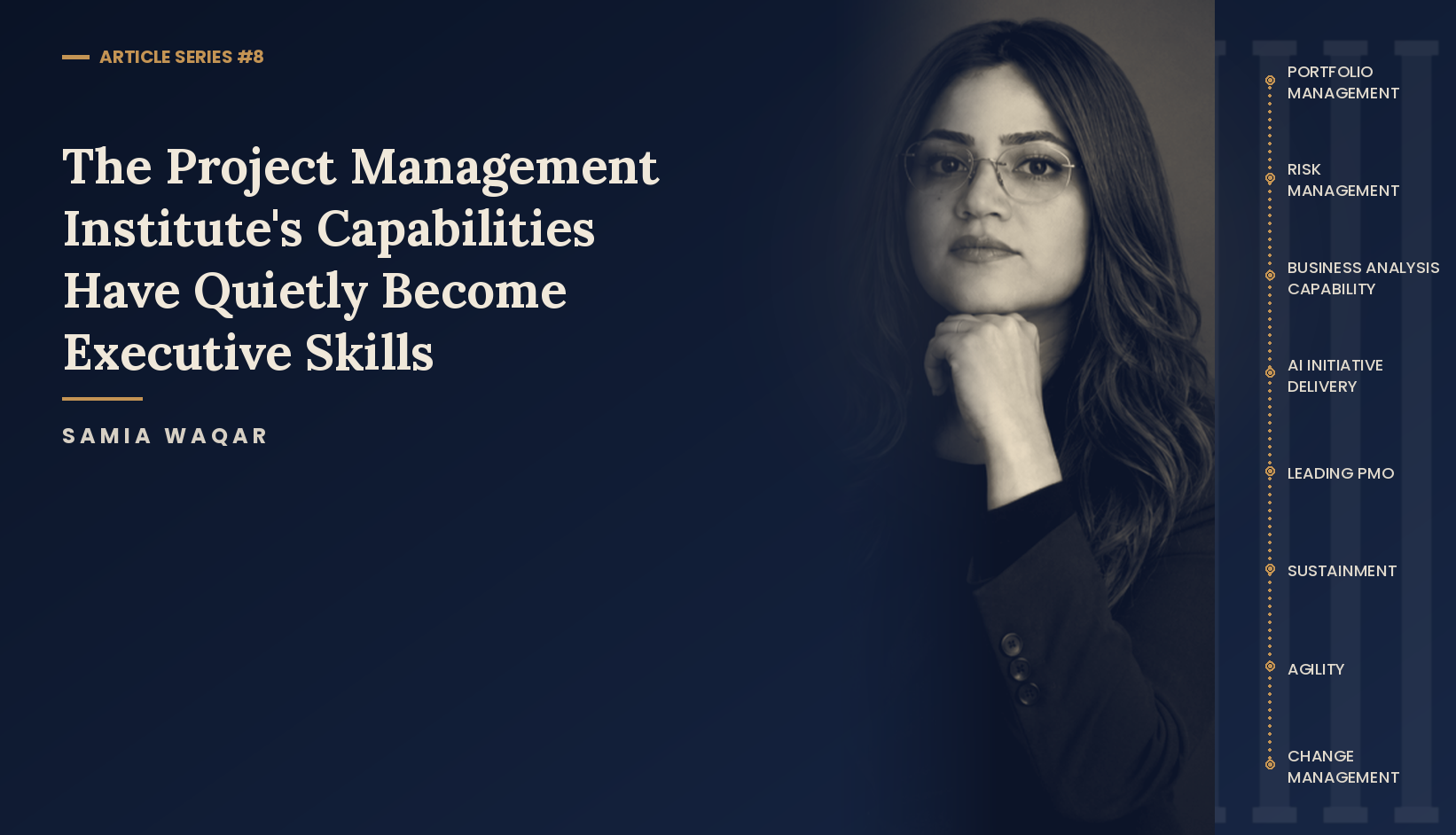
PMI's certification catalog can look, at first glance, like a list of narrow specialisms. Read differently, it's a single map of one underlying capability: the ability to lead change from an honest initial diagnosis through to value the organization can actually measure.
- PMP (Project Management Professional) leading a single initiative end to end
- PgMP (Program Management Professional) and PfMP (Portfolio Management Professional) — coordinating multiple initiatives and steering the portfolio toward strategy
- PMI-ACP (Agile Certified Practitioner) — adaptive, iterative delivery
- PMI-RMP (Risk Management Professional) — governing uncertainty
- PMI-PBA (Professional in Business Analysis) — defining the real need before resources are committed
- PMI-PMOCP (PMO Certified Professional) — building a value-driven execution office
- PMI-CPMAI (Certified Professional in Managing AI) — leading AI-based initiatives
Each credential names a distinct piece of the same overall competency: leading change with discipline from diagnosis to measurable outcome.
What This Means for Every Senior Leader
If most organizational value now comes from change, and PMI has spent five decades codifying how change is led well, the conclusion is hard to avoid: these are no longer project manager skills. They're leadership skills. But this is exactly where the idea gets misread and the misreading is expensive.
A certification proves that someone has studied a capability area. It does not prove that person can exercise that capability at the senior level under political pressure, incomplete information, competing stakeholders and consequences that extend well beyond a single project.
Professional standards describe a body of knowledge. Executive capability describes behavior under accountability. The two overlap, but they are not interchangeable and treating a credential as proof of executive capability is precisely the gap we unpack in The Delivery Capability Gap.
From Practitioner Skill to Executive Judgment
The translation only runs one direction: practitioner capability becomes executive capability when it's applied to decisions only senior leaders are positioned to make.
A project manager knows how to maintain a risk register. A senior leader has to recognize when an entry on that register has crossed the threshold that demands changing the portfolio, halting a program or escalating to the board. A project manager can report portfolio status. A senior leader has to decide when a workstream is no longer the best use of the organization's limited strategic capacity and has to hold a named owner accountable for a named benefit long after the delivery team has moved on.
The practitioner skill matters. Executive capability is what happens when that skill gets elevated to where accountability actually lives the same argument we build out in Modern Initiative Leadership.
The Professional Bodies Are Already Saying This
PMI's own guidance has started making this shift explicit. Its practice guide on project management offices deliberately frames the PMO for an executive audience not as a reporting mechanism, but as a strategic partner that senior leaders need to learn how to direct.
Antonio Nieto-Rodriguez captures the underlying reason in one line of argument: as value migrates toward change initiatives, questions that used to live inside the project office now sit on the executive agenda. And as AI increasingly absorbs technical and analytical work, what's left for the leader is the judgment no standard can automate whether an initiative is still the right one, whether its benefits are still real, and whether the behavioral and governance changes the technology demands have actually been designed. This is the exact tension we work through in Leadership Capability in the Age of AI.
How Strong Is the Evidence, Really?
It's worth being precise here rather than overselling the case. The research linking strategic judgment, stakeholder alignment and adaptability to successful change is strong and consistent but it's converging, not fully settled. PMI's own data is telling on this point: only around 18% of professionals demonstrate high business acumen and that smaller group reports materially lower project failure rates.
The direction of the evidence is clear enough to act on. It isn't yet complete enough to declare the case closed and we won't pretend otherwise in this series as we explore further in Closing the Strategy Execution Gap.
The Real Takeaway
PMI's codified capabilities matter more today than at any point in the organization's history and not just to project managers. They matter to every leader accountable for change, which in a project economy is close to every senior leader. The task isn't sending executives through a project management course. It's translating a well-established body of capability into the actual behavior of the room where decisions get made.
That's also where the harder problem shows up: these capabilities are taught, certified and practiced in separate tracks, in separate vocabularies while a leader has to draw on all of them at once, in no particular order in the middle of a live decision. Having the capabilities isn't the same as holding them together and that gap is what the next stage of this conversation needs to address.
If this raises questions about how your organization treats project, portfolio, risk and change capability as specialist tracks or as an executive requirement that's worth working through properly. You can start with our leadership capability framework or take the diagnostic to see where the gap sits in your own organization.
Frequently Asked Questions
Is PMI certification only relevant for project managers?
Not anymore. PMI's frameworks were originally built for project specialists, but as more organizational value comes from change initiatives rather than steady operations, the underlying capabilities risk governance, stakeholder alignment, benefits ownership have become directly relevant to senior leaders and executives, not just the people running individual projects.
What's the difference between a PMI credential and executive capability?
A credential demonstrates that someone has studied a body of knowledge and can apply it in defined conditions. Executive capability is the ability to exercise that same knowledge under real accountability incomplete information, competing stakeholders, political pressure and consequences that go beyond a single project or program.
Which PMI certifications matter most for senior leaders?
Rather than one certification, it's the combination that matters: PMP for end-to-end delivery, PgMP and PfMP for portfolio-level judgment, PMI-RMP for risk governance and PMI-CPMAI for AI-led initiatives. Together, these map a single leadership capability leading change from diagnosis to measurable value.
How reliable is the evidence that these capabilities improve business outcomes?
The evidence is strong but still developing. PMI's own research shows only about 18% of professionals demonstrate high business acumen, and that group reports significantly lower project failure rates. The pattern is consistent and actionable, though the research base is still converging rather than fully conclusive.
Why can't AI replace this kind of leadership judgment?
AI is increasingly capable of handling technical and analytical project work, but it can't decide whether an initiative is still strategically worth pursuing, whether its expected benefits are still realistic or whether the organization has actually built the behavioral and governance changes a new technology requires. That judgment remains a distinctly human, executive responsibility.