Why the Complexity of Modern Initiatives Has Outgrown Traditional Leadership Models
Why the leadership models that built yesterday's organisations can't govern today's interconnected initiatives.
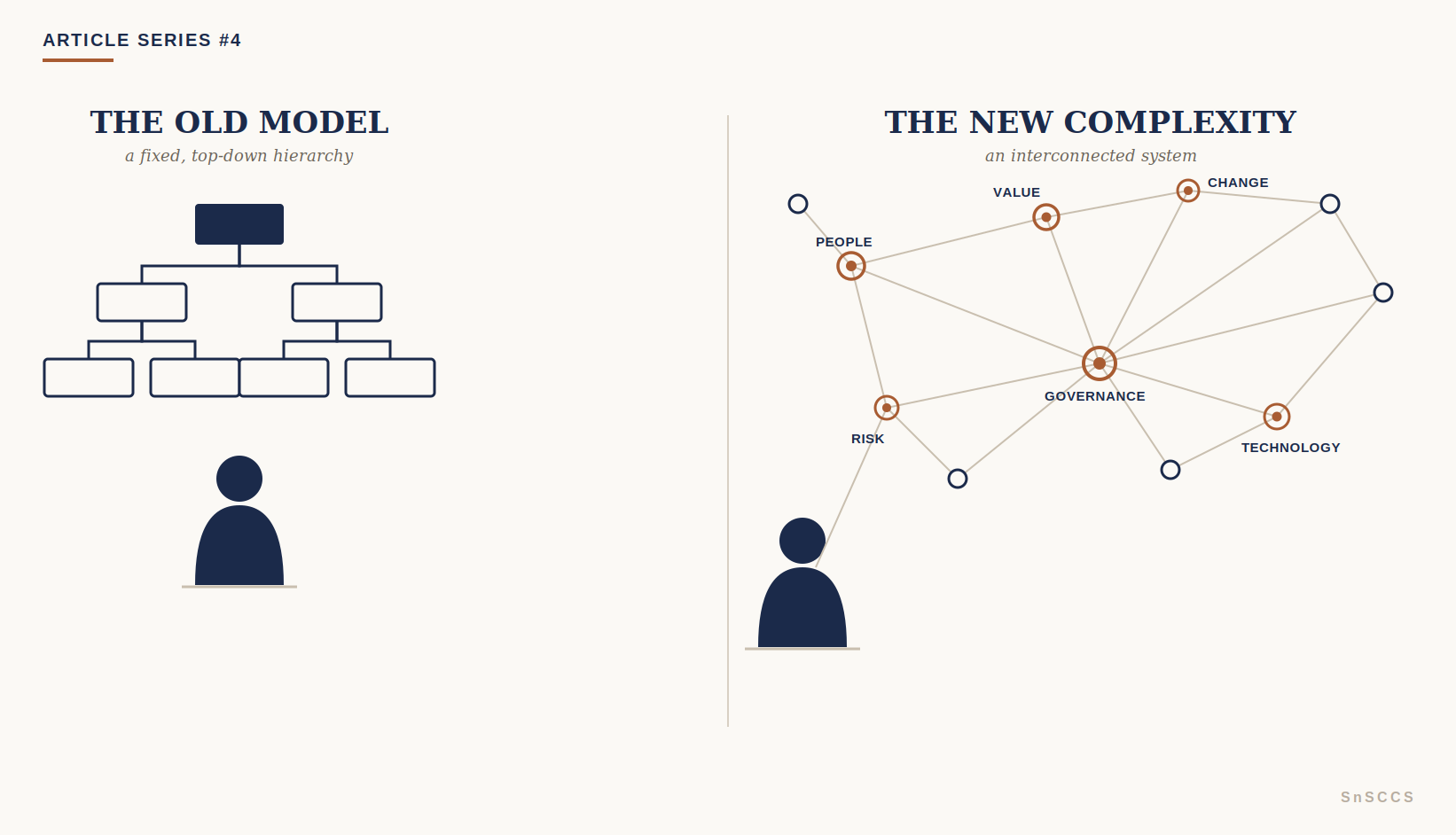
A project used to be a line: a start date, an end date, a defined scope and a leader who managed inside clear boundaries. That world is gone. A modern initiative today behaves less like a line and more like a web a living network of technology, people, process, governance, risk and change, all pulling on each other at once. And most senior leaders can feel the mismatch, even if they can't always name it.
That discomfort isn't a personal failing. It isn't about intelligence, effort or experience. It's structural. The leadership models most executives were trained on were built for a different kind of work and the distance between that training and today's reality keeps growing.
From Running the Present to Building the Future
In an earlier piece in this series, I made the case that organisations are now spending far more energy building what comes next than maintaining what already exists. This shift isn't cosmetic it changes the very nature of the work.
When effort moves from operations to initiatives, it stops being a simple task with a checklist. It becomes an interconnected system where technology decisions, people decisions, governance requirements, compliance obligations, risk exposure and adoption curves all interact. None of these can be led or even understood in isolation.
This is precisely the gap that a role agnostic approach to leadership is designed to close: leadership capability that isn't confined to a job title, but sits wherever the dependencies and trade-offs actually converge.
The Modern Initiative Is a Web, Not a Line
A modern initiative rarely stays inside its own boundary. It sits inside a wider portfolio of change, where decisions in one place quietly reshape outcomes somewhere else entirely.
- A decision in one initiative shifts the risk exposure of another.
- A slip in one workstream holds back a capability that several other teams are waiting on.
- A benefit promised in one programme only materialises if an unrelated operational change happens on schedule.
None of this is unusual anymore. It's simply how change moves through a modern organisation as a web of dependencies, not a sequence of independent tasks.
Why Traditional Leadership Models Fall Short
Conventional leadership approaches were shaped for a steadier era one built around functions, departments, defined reporting lines and bounded accountability. Inside that structure, a strong functional leader could thrive simply by mastering their own patch.
That boundary has effectively dissolved. Today's initiatives cut across functions, move faster than formal reporting structures can keep up with, and force decisions to be made while the picture is still incomplete not once all the facts are in. A leader who excels within a single, stable function can still find themselves out of their depth the moment the work refuses to respect that function's edges.
The Evidence Is Hard to Ignore
The numbers back up what many leaders already sense.
Antonio Nieto-Rodriguez, writing in Harvard Business Review, has pointed out that project-based work has overtaken day-to-day operations as the primary engine of organisational value, with project-driven economic activity expected to approach 20 trillion dollars by 2027. At the same time, he notes that roughly only a third of projects worldwide actually succeed.
That statistic isn't really a comment on project managers. It's evidence that organisational leadership hasn't kept pace with the complexity it's now expected to govern.
Bent Flyvbjerg and Dan Gardner arrive at a similar conclusion in their research on how large-scale initiatives actually play out: major undertakings disappoint far too consistently for it to be chalked up to bad luck or individual missteps. The pattern points to something systemic.
If you want the fuller evidence base behind this argument, it's worth exploring the research underpinning the RAPL framework.
This Is a Leadership Problem, Not a Project Management Problem
Here's the reframe that matters most: this complexity is not, at its root a project management issue. It's a leadership issue.
Managing the mechanics of a single project is still a valuable discipline with its own tools and standards. But governing an entire connected system of initiatives holding dependencies, risks, stakeholders and benefits in view simultaneously, and making sound calls while information is still incomplete is a different kind of capability altogether. It sits above any one function or job title. It's leadership work, whether or not the person doing it ever holds the formal title of project manager.
This is exactly why so many organisations feel this pain and so few resolve it. The instinctive response to rising complexity has been to add more methods, more tools, more reporting as if the shortfall were purely one of execution. But if the leadership model itself was designed for a simpler kind of work, no amount of process layered on top will close the gap. It just adds weight without adding capability.
Building the Capability Deliberately
If the leadership model itself is the real constraint, then no framework, dashboard or status report placed on top of it will change the outcome. The ability to govern complex, interconnected change has to be built on purpose as a genuine leadership capability, not a side skill attached to a role and positioned exactly where the dependencies, risks and trade-offs actually converge.
That is a fundamentally different investment than simply buying more project management capacity. It's the foundation that the RAPL certificate programme is built to deliver and the same principle behind why organisations partnering with RAPL start by locating exactly where their leadership gap sits using the RAPL diagnostic.
Where the Gap First Shows Up
Recognising that modern initiatives have outgrown the models used to lead them is only the first step. The next question is where that gap actually becomes visible in an organisation. It rarely shows up in the strategy document. It shows up in the organisation's capacity to actually deliver and that's the thread this series picks up next.
A question worth sitting with: in your organisation, is the harder part of a modern initiative the work itself or the web of dependencies, stakeholders and decisions surrounding it? Share your view in the comments.
If this gap is something you're already sensing inside your own organisation, it's worth talking through. You can book a complimentary strategy conversation with Samia or explore more tools and insights in the RAPL resource library.
Frequently Asked Questions
Why do traditional leadership models struggle with modern initiatives?
Traditional models were designed around stable functions, clear reporting lines and bounded accountability. Modern initiatives cross functional boundaries, move faster than reporting structures can adapt and require decisions before all the facts are known conditions these older models were never built to handle.
What is role agnostic project leadership?
Role agnostic project leadership is the idea that the capability to govern complex, interconnected initiatives shouldn't be tied to a single job title. It belongs wherever dependencies, risks and trade-offs actually meet regardless of whether that person formally holds a project management role.
Is this a project management problem or a leadership problem?
It's fundamentally a leadership problem. Project management disciplines remain useful for running individual projects, but governing an entire connected portfolio of initiatives with shared risks, dependencies and benefits demands a leadership capability that sits above any single project or function.
Why do most projects still fail despite better tools and methods?
Research cited by Antonio Nieto-Rodriguez in Harvard Business Review shows only around a third of projects worldwide succeed, despite decades of investment in methods and tools. The reason is structural: the leadership models guiding this work haven't evolved at the same pace as the complexity of the work itself.
How can an organisation start closing this leadership gap?
The first step is identifying exactly where the gap sits through a structured diagnostic assessment, followed by building the capability deliberately through dedicated leadership development rather than simply adding more process on top of the existing model.
Where can I learn more about the research behind this argument?
The evidence base includes work referenced from Harvard Business Review, along with Bent Flyvbjerg and Dan Gardner's research on why large-scale initiatives consistently underdeliver.
This article is part of an ongoing series on why modern initiatives demand a new model of leadership. Learn more about RAPL and Samia Waqar's work or explore the full resource library for more insights.