
Why Most Organizations Now Have More People Building the Future Than Managing the Present
Why the workforce has already shifted toward delivering change and leadership development hasn't caught up.
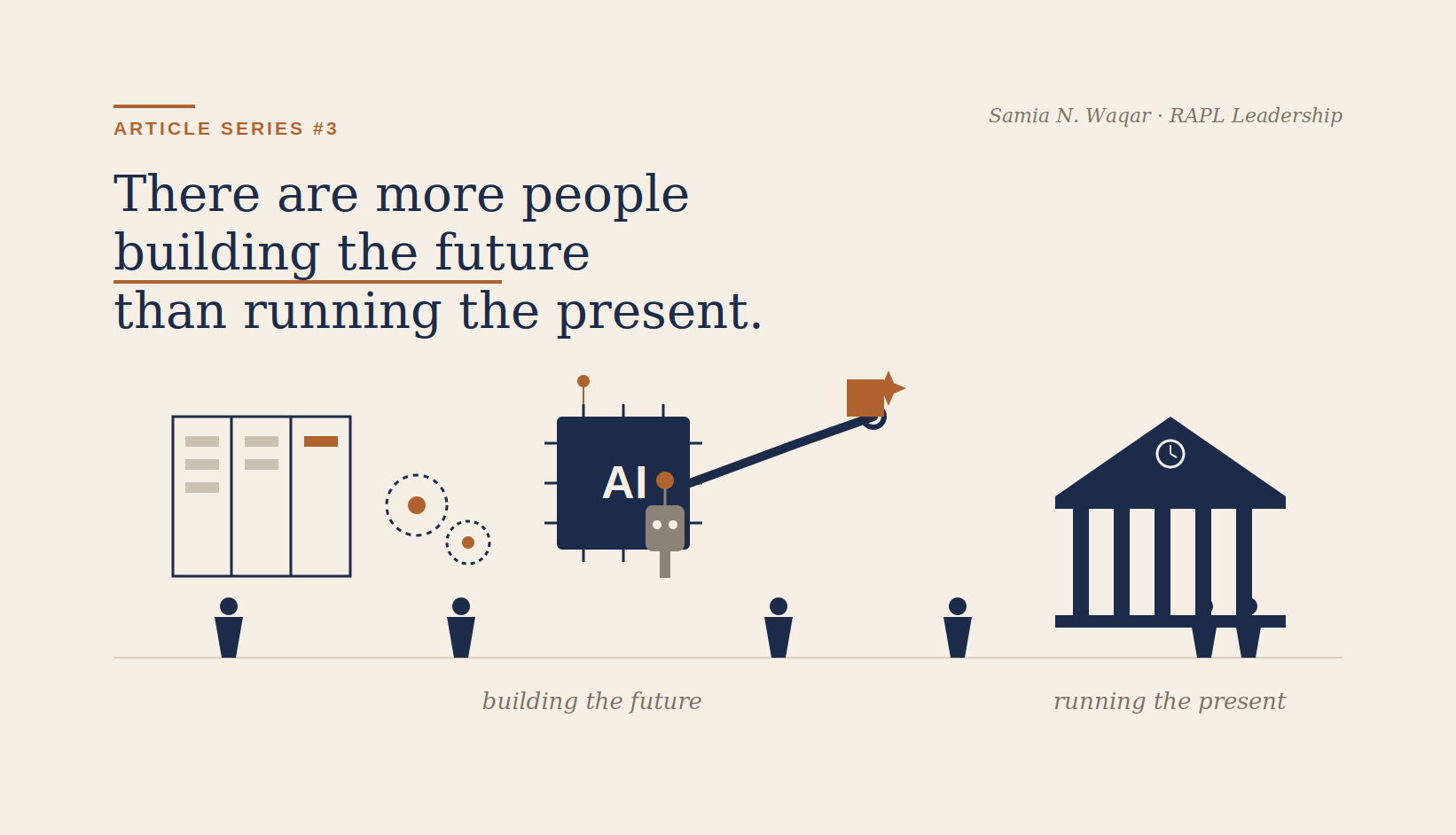
Delivering change has quietly become one of the biggest categories of work in the global economy yet senior leadership is still shaped for an operational world that no longer exists in most companies. Walk into any large organization today and count what people actually spend their day doing. A shrinking share are keeping existing processes running. A growing majority are somewhere else entirely heads down on something that doesn't exist yet: a new system a new market, a merger, a migration, an AI rollout, a care model that's never been tested here before.
They aren't maintaining the present. They're constructing the future. And in most organizations, they now outnumber almost everyone else.
Our earlier piece made the case that organizations have become project-driven while leadership development has stayed rooted in operations and that this gap is widening. That argument deserves evidence, not just assertion. The proof is sitting inside every workforce, hiding in plain sight.
The Headcount Tells the Story
Start with the numbers, because they're striking. Close to forty million project professionals are working worldwide today. Compare that against two of the most recognizable professions on the planet: roughly twenty-five million software developers and around thirty million nurses. The people whose entire job is delivering change have grown larger in number than the developers who build the world's software and they now sit alongside the nurses who keep it healthy. This isn't a fringe profession anymore. It's become one of the largest categories of human work on earth.
This kind of scale doesn't show up as an accident it's the direct result of how fast organizations are restructuring themselves around delivery rather than routine operations, something we track closely in our research on leadership and organizational change.
A Bank With More Engineers Than Bankers
To make it concrete, consider a simple but powerful observation often made about large financial institutions: a major bank today typically employs more software engineers than bankers. Sit with that for a second. Walk the floors of a large bank and you'll find enormous teams working in technology, product, data, cybersecurity, AI and transformation. None of them are running last year's banking operations every one of them is building next year's bank. The sign outside still says bank. What's happening inside is the work of a technology, product, risk and transformation organization that happens to hold a banking license.
And the bank isn't an outlier it's the blueprint. The same pattern repeats across every industry:
Retailers are rebuilding around digital commerce and supply-chain modernization
Hospitals are standing up new care models and the data platforms underneath them
Manufacturers are wiring factories for automation and sustainability
Insurers, telecoms and governments are deep into regulatory modernization, customer experience redesign and AI adoption
None of this is steady-state work. It's future-state work, and it no longer starts and stops it's continuous. Organizations are now building the future the way they once ran the present: constantly, as the main event, not a side project.
Who Is Actually Doing This Work?
It's tempting to picture forty million project managers with Gantt charts, tucked away in a project management office. That picture is outdated. The people closest to the profession describe it differently: the real changemaker is anyone delivering change, regardless of the title on their door. Change happens through successful projects full stop.
The scale backs this up. Industry research points to demand for up to thirty million additional delivery professionals over the next decade and global labor market forecasts consistently place project leadership among the roles driving employment growth through the rest of the decade. This work has walked straight out of the project office and spread across the entire enterprise sales, operations, clinical teams, product, everywhere. It's a pattern we see repeatedly when working directly with organizations trying to figure out who is actually leading change internally, versus who simply holds the title.
AI Has Made the Pattern Impossible to Ignore
The newest and fastest-moving version of this work makes the point sharper still. So much of the future is now being built with artificial intelligence that leading AI initiatives has become its own discipline often called Cognitive Project Management for AI. The people doing this work are rarely called project managers at all. They're data scientists, clinicians, product owners and operators all of them delivering change under conditions no existing operational playbook ever anticipated.
Where the Story Gets Uncomfortable
Here's the uncomfortable turn: if building the future is now happening everywhere, across every function, led by people with every kind of title, then the ability to lead that work can no longer belong to a single department. Yet that's exactly how most organizations still treat it.
Delivery capability is still locked inside one function. Even the office built to house it the PMO is only now being redefined from a control function into a genuine value enabler. Meanwhile organizations continue grooming their most senior people for operational command, the way it's always been done and then act surprised when a well-funded transformation stalls under executives who were never actually prepared to lead one.
The workforce has already reorganized itself around building the future. Leadership development hasn't caught up.
The One Honest Conclusion
A capability that the entire organization now depends on practiced by leaders across every discipline cannot stay a narrow technical skill owned by a handful of specialists. It has to be built as a genuine leadership capability, one that belongs to no single role and is developed at the level where the real portfolio of strategic bets actually lives.
That's a fundamentally different goal than simply hiring more project managers. It's what a role-agnostic approach to leadership development is built to solve and it's the foundation of the RAPL Leadership framework, designed specifically for leaders who are expected to deliver change regardless of their formal title. Leaders who want to build this capability formally can also explore the RAPL Leadership certification built around the same framework.
Proving that the shift is real only sharpens the next question: can the leadership model organizations inherited actually carry the weight of how complex this future-building work has become? For most, the honest answer isn't comforting and organizations that want a clear-eyed view of where they stand can start with a leadership diagnostic built around exactly this gap.
A question worth sitting with: in your industry, are more people running the present or building the future?
If this shift is already visible in your organization, it's worth exploring further browse our practical resources on leading change or learn more about RAPL Leadership and the work behind this series at raplleadership.com.
FAQs
Q: What does it mean for an organization to be project-driven rather than operation-driven?
A project-driven organization spends most of its energy on work that creates something new new systems, markets, products or capabilities rather than simply maintaining existing processes. Most large organizations today have quietly shifted into this mode without updating how they develop the leaders responsible for it.
Q: Why are there now more project professionals than software developers or nurses worldwide?
As organizations across every industry banking, retail, healthcare, manufacturing, insurance and government undertake continuous transformation and modernization efforts, the number of people whose core job is delivering change has grown rapidly, surpassing even some of the world's largest established professions.
Q: Is this only relevant to people with project manager in their title?
No. The people leading change today include data scientists, clinicians, product owners, engineers and operators across every function. Delivery capability has spread well beyond the traditional project management office, which is why leadership development for this work needs to reach far beyond one department.
Q: Why do transformation efforts stall even when they're well-funded?
Most senior leaders are still developed and promoted based on operational command running the present well rather than the skills needed to lead ambiguous, cross-functional change. When that mismatch meets a major transformation, execution suffers, regardless of budget.
Q: How should organizations respond to this shift?
Leadership capability for delivering change needs to be treated as a core leadership skill, not a specialist function. This means assessing where the organization currently stands, understanding the underlying leadership framework required and investing in certification or development programs built specifically to close this gap.
Q: Where can I learn more about this research and approach?
This article is part of a broader research series on leadership and organizational change, along with practical resources, real-world application across organizations and background on the work behind it.