AI Can Execute. It Cannot Take Responsibility — Why Leadership Is Becoming the Real Competitive Edge
Why leading change not adopting the latest tool is the one advantage AI cannot replicate.
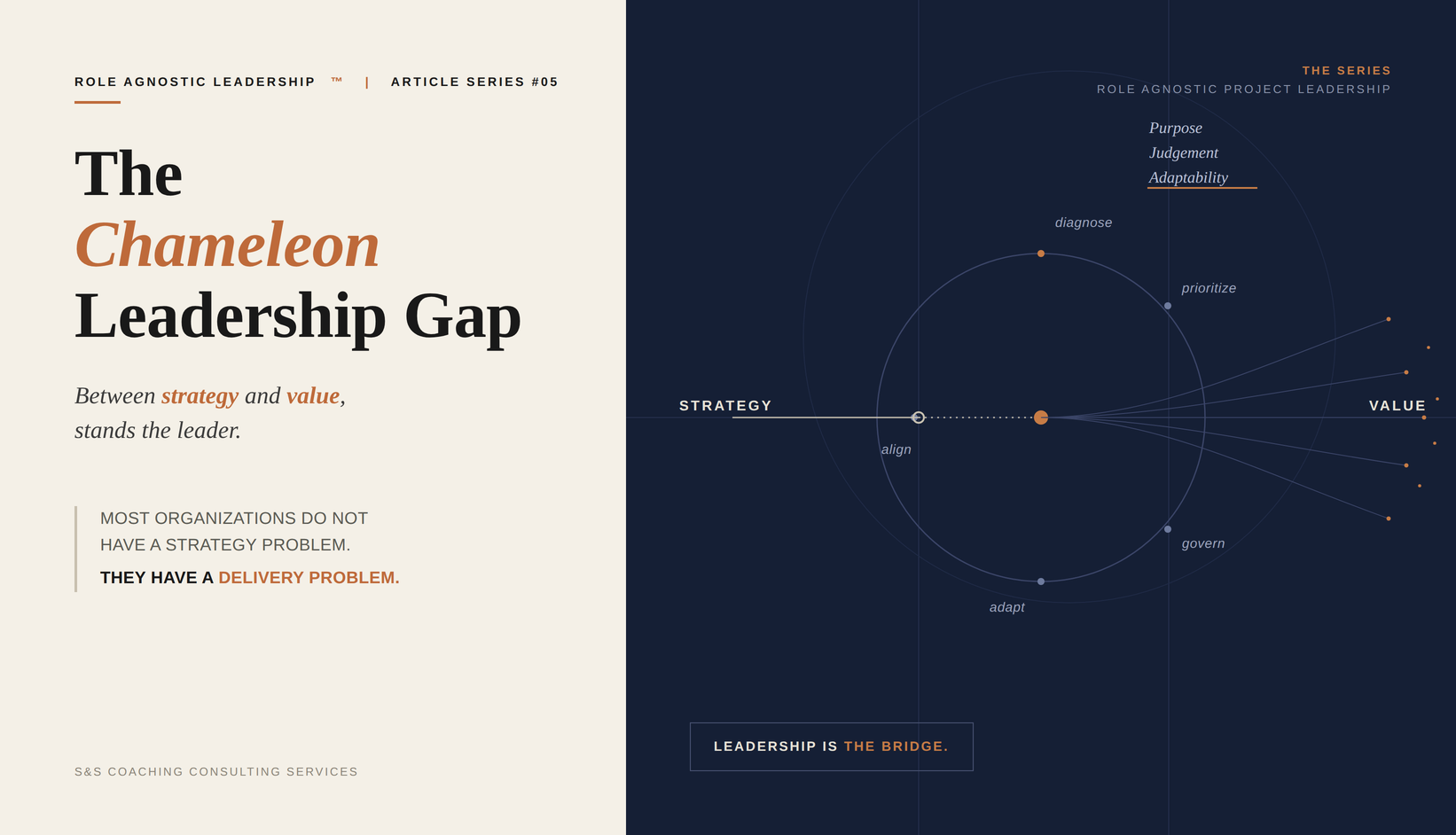
An earlier piece in this series made an observation that lands instantly with most senior executives: the issue most companies wrestle with isn't really strategy it's follow-through. The plans exist on paper. Budgets have been signed off. Priorities are agreed in the boardroom. What's actually missing is the organisational muscle to govern that work, execute it adjust course mid-flight and prove it delivered value. That earlier discussion ended on a pointed question: what happens once a force bigger than internal complexity enters the equation? That force is artificial intelligence and it doesn't shrink the execution problem. It makes it far more important.
The Old Advantage Is Disappearing
For decades a large part of what made one organisation beat another was purely transactional who could analyse, draft, code, process and optimise faster than the competition. That edge is eroding fast. AI happens to be extremely good at exactly this category of work: spotting patterns, following rules, repeating processes, crunching data, generating first drafts and tightening operations.
Dave Ulrich has pointed out that this is precisely the entry-level work through which people historically built their careers inside organisations. The Stanford Digital Economy Lab, through research led by Erik Brynjolfsson has put a number on the disruption early-career employees in roles most exposed to AI have seen employment fall by roughly 13% since generative AI went mainstream, while more experienced professionals in the same fields have held their ground or advanced.
The takeaway goes beyond hiring statistics. Once a skill becomes cheap and universally accessible, it stops functioning as an advantage at all. A Harvard Business School study a field experiment run by Karim Lakhani's team with 758 consultants at Boston Consulting Group found that GPT-4 improved output quality on AI-suited tasks by over 40% and cut completion time by more than a quarter with the biggest gains going to the least experienced consultants, effectively closing the performance gap between strong and weak performers.
The floor is rising for everyone at the same time. What organisations are capable of doing is being standardised. What now separates them is how well their leaders can steer change.
If Technical Skill Isn't Scarce Anymore, What Is?
This is the uncomfortable question most leadership teams haven't sat with honestly yet. And the answer is the one thing AI simply cannot provide: ownership of the outcome.
AI can support a decision it can't be accountable for it. It can flag a risk it can't carry the consequences of that risk. It can produce a plan in seconds but it cannot bring a divided leadership team to consensus, manage trade-offs as the situation shifts or keep an organisation focused on delivering value long after the initial excitement fades. That is leadership work and no model performs it.
The real differentiator going forward is human leadership capability judgment, ethics, governance, protecting and defining value, leading change and the discipline to turn strategic intent into results that can actually be measured. Antonio Nieto-Rodriguez has argued that in today's Project Economy, value comes from change itself, not routine operations. Leading that change is exactly where the advantage now sits. Pierre Le Manh, who heads the Project Management Institute, has made the same point about the AI era the people who convert ideas into reality are the ones carrying transformation forward.
What This Leadership Actually Looks Like
It's important to be specific here this isn't the steady, predictable management of a function that runs on autopilot. This is adaptive leadership: the ability to move through diagnosis, prioritisation, delivery, governance and course-correction without ever losing sight of purpose or accountability.
Change doesn't hold still, so the person leading it can't either. Making judgment calls under real ambiguity. Staying accountable long after a project has technically launched. Having the discipline to pull the plug on an investment that's stopped creating value. These are capabilities AI cannot replicate and capabilities organisations increasingly can't afford to leave to chance or assume already exist.
Building this deliberately rather than hoping it emerges on its own is the foundation of approaches like the Role Agnostic Project Leadership™ framework, which treats leading change as a teachable, structured capability rather than an innate trait a handful of people happen to have.
The Question Most Organisations Are Avoiding
If leadership capability really is the new competitive advantage, the harder question is whether most organisations actually have it or whether the Project Economy has quietly exposed a gap that years of technical training was never designed to close.
That's worth sitting with. As AI levels the technical playing field are you actively investing in the one advantage it cannot copy or are you still competing on the one it's steadily erasing?
Where the Competition Is Actually Happening Now
The basis of competition has quietly shifted. It used to be about what an organisation could do and AI is answering that question for everyone, all at once. Now it's about how well an organisation's leaders can lead change through uncertainty and that question has no automated shortcut.
That advantage has to be built on purpose. It's a fundamentally different exercise from adopting a new tool, which every competitor will have licensed within the same quarter.
Recognising that, though, only raises the next question. If leadership capability is the advantage that matters, do organisations actually possess it or has the Project Economy quietly opened a gap that conventional training and tooling were never built to address? Naming that gap precisely its cause and what it costs organisations that assume their leadership development is already keeping pace is where this series goes next.
If this conversation is relevant to your organisation, you can explore where the gaps might be through a leadership capability diagnostic, review the supporting research behind this series or book a complimentary strategy conversation to talk it through directly.
FAQs
What does leadership capability mean in the age of AI?
It refers to the human-driven skills AI cannot replicate judgment under ambiguity, ethical decision-making, governance and the ability to lead an organisation through change and hold it accountable for realising value. As AI absorbs routine technical work, this capability becomes the primary differentiator between organisations.
Why can't AI replace leadership judgment?
AI can inform decisions, model risks and draft plans, but it cannot own the consequences of a decision, align a divided team, or stay accountable for outcomes long after a project launches. Leadership requires responsibility and judgment under real-world ambiguity something outside AI's scope.
What is adaptive leadership and why does it matter now?
Adaptive leadership is the ability to move through diagnosis, prioritisation, delivery, governance and course-correction without losing clarity of purpose. It matters now because change is constant and non-linear leaders who can only manage stable, predictable functions are increasingly at a disadvantage.
What is the Project Economy?
A concept introduced by Antonio Nieto-Rodriguez describing how value today is created through change and transformation rather than routine, repeatable operations making the ability to lead change a central organisational capability rather than a side skill.
How can organisations build this kind of leadership capability deliberately?
Through structured, teachable frameworks rather than assuming leaders will develop these skills on their own. Purpose-built programs and certification pathways are designed specifically to close this gap for C-suite and senior leaders.
How do I know if my organisation has this gap?
A structured leadership capability diagnostic is the fastest way to identify where the gap sits before it becomes a costly execution problem. Reviewing available resources and prior work done with similar organisations can also provide useful context.