Why Strategy Fails in Delivery, Not in Design — The Real Leadership Gap
Why adaptive, role-agnostic leadership not a sharper strategy is what actually carries value across the finish line.
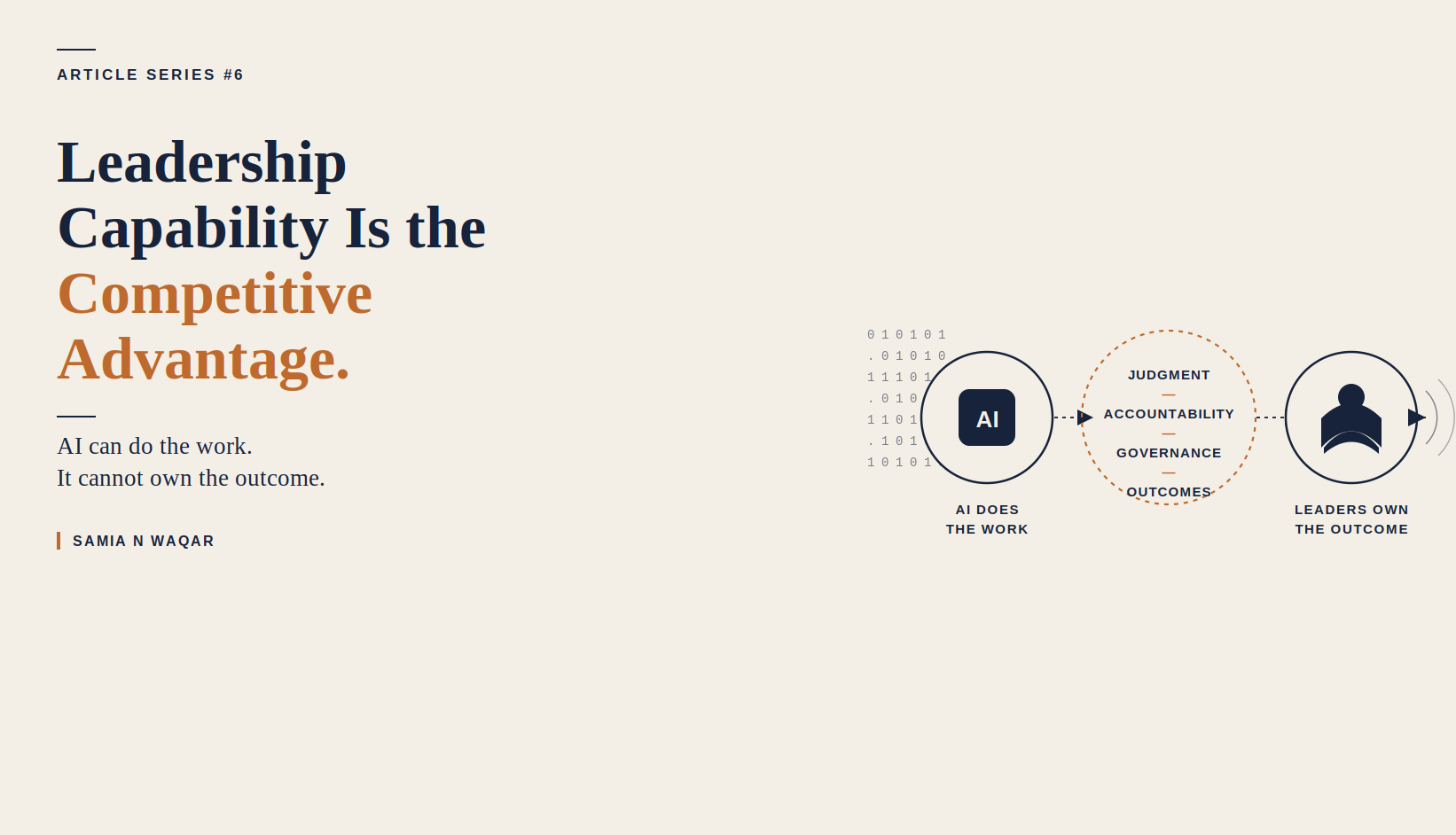
Underneath every execution problem is a leadership capability gap.
Sit in enough strategy review meetings and one pattern keeps repeating itself. The strategy documents are usually fine. The priorities are clear, the analysis is solid, the ambition is real. What breaks down is what happens after the strategy is approved the long, messy road from a decision on paper to a result people can actually point to. Organizations don't struggle to decide what to do. They struggle to carry that decision all the way to value.
This isn't a comfortable thing to admit, because strategy is where the attention, the budgets and the prestige usually sit. But the evidence keeps pointing the same direction. Robert Kaplan and David Norton, after two decades studying how strategy connects to day-to-day operations, found that the real breakdown wasn't in how strategy gets formed it was in the long stretch between an approved plan and actual performance change on the ground. A strategy can look sharp on paper and still lose all its power as it passes through portfolio decisions, cross-team coordination, delivery work and adoption. That's not a planning failure. It's a delivery failure.
Delivery Is a Leadership Act, Not an Administrative One
In today's project-driven organizations, delivery isn't a mechanical checklist that starts once the thinking is finished. Antonio Nieto-Rodriguez has argued that value today is created through change itself through initiatives that cut across departments and play out under real uncertainty. Pierre Le Manh, who heads the Project Management Institute, has put project and transformation leadership at the very center of the profession, especially as the AI era reshapes how work gets done precisely because this is now where value actually gets made.
Carrying a strategy through that kind of terrain isn't administration. It's leadership. Which means the delivery problem that so many organizations struggle with isn't really about methodology, tooling, or reporting dashboards. At its root, it's a leadership capability problem.
The Different Modes Delivery Demands From a Leader
Look closely at what delivery actually asks of the person leading it and the diagnosis gets sharper. The demands never sit still.
- At the start it requires honest diagnosis of the real problem not the comfortable version of it.
- Soon after, it demands tough calls about which initiatives get funded and which get refused.
- Then it requires coordination making sure teams deliver benefits, not just outputs.
- Then governance including the discipline to kill work that should be stopped.
- Then adaptation because conditions shift under the plan almost as soon as it's approved.
Each of these is a completely different mode of leadership. A single initiative will move through all five. A leader who's only fluent in one mode will watch the work stall the moment it crosses into the next.
The Chameleon Leader: Adapting Approach, Not Identity
This is exactly the kind of adaptive range that leadership research has examined for decades. Robert Goffee and Gareth Jones, writing in Harvard Business Review, described great leaders as people who shift their behavior to match very different situations while staying authentically themselves an idea they framed through the image of the leader as a kind of chameleon.
That image is easy to misread, so it's worth being precise about it. The chameleon leader changes their register, not their character. They adjust their approach, their communication, their style while their judgment and principles stay fixed. Applied to delivery, that's exactly the leader an initiative needs: someone who can move fluidly from diagnosis to prioritization to governance to adaptation without losing themselves in the process.
Dave Ulrich has recently extended this same idea down to the level of the individual professional, arguing that the people who thrive alongside AI are the ones who function as chameleons bringing their capability into any setting they're placed in. What he describes for the individual employee applies with even more force to the leader, since it's the leader who sets the conditions everyone else's work depends on.
This is the same underlying idea behind what we call role-agnostic leadership capability that transfers across roles and situations, rather than capability tied to a single job description.
Why This Capability Is So Scarce
Once you see it this way, the scarcity starts to make sense. Most leadership development programs were built to produce operators leaders selected and promoted for running one stable function extremely well. That's real, valuable capability. But it's a single mode.
Put an accomplished operator in charge of a cross-functional initiative, and you've asked them to do something they were never actually developed to do. The initiative absorbs the cost of that mismatch in delays in drift and in benefits that quietly never show up. Seen this way, the delivery problem and the leadership problem aren't two separate issues. They're one problem, viewed from two different ends.
The Real Fix Isn't a Sharper Strategy
Which leaves one honest conclusion. If value is won or lost during delivery and delivery depends on leaders who can adapt across the entire arc of an initiative, then the real competitive advantage isn't a sharper strategy document and it isn't a heavier process. It's adaptive, role-agnostic leadership capability built deliberately, not left to chance.
That's a fundamentally different task than planning more carefully. Organizations serious about closing this gap need a structured way to build it which is exactly what programs like the Role Agnostic Project Leadership certification and the broader work we do with organizations are designed around.
Naming the delivery problem this way opens up a harder question, though: if adaptive leadership is what actually carries strategy to value, what happens to its worth as AI takes over more and more of the technical and transactional work that used to set leaders apart? The honest answer isn't that this capability matters less it's that it starts to matter more than almost anything else. That's the next part of this conversation.
If you want to see where your own organization stands on this our leadership diagnostic is a good place to start and our research page goes deeper into the evidence behind this argument.
FAQs
Why do strategies fail even when the plan itself is good?
Because strategy and delivery are two different disciplines. A strong plan can still fail if the organization lacks leaders capable of carrying it through prioritization, coordination, governance and constant adaptation the actual work of delivery.
Is the delivery problem a process issue or a leadership issue?
It's fundamentally a leadership issue. Better tools and reporting can support delivery, but they can't substitute for leaders who can adapt their approach across the different phases an initiative moves through.
What does role-agnostic leadership mean?
It refers to leadership capability that isn't tied to one specific function or title the ability to lead effectively across diagnosis, prioritization, governance and change, regardless of the formal role. Learn more about the RAPL framework.
What is a chameleon leader?
A concept from Goffee and Jones' research describing leaders who adapt their behavior and communication style to fit different situations, while keeping their core judgment and values constant.
How can organizations start closing this leadership-delivery gap?
It starts with an honest assessment of current leadership capability, followed by deliberate, structured development rather than ad-hoc training. See our diagnostic tool and resources to get started.
This article is part of an ongoing series on leadership and strategy execution. To explore the full framework, visit raplleadership.com or read more about our work.
Sources
Kaplan, R. S. and Norton, D. P. (2008) The Execution Premium: Linking Strategy to Operations for Competitive Advantage. Boston: Harvard Business Press.
Nieto-Rodriguez, A. (2021) 'The Project Economy Has Arrived', Harvard Business Review, November–December 2021.
Goffee, R. and Jones, G. (2000) 'Why Should Anyone Be Led by You?', Harvard Business Review, September–October 2000.
Ulrich, D. (2026) 'AI, Organization Form and Personalized Career: The Chameleon Employee', LinkedIn.