Leadership Development for Project Leaders: Skills, Roadmap and Future Demands
Why technical project knowledge is not enough, and how project leaders can build the leadership skills teams rely on.
A project can have a flawless schedule and still lose its team halfway through. That is the gap leadership development for project leaders is meant to close. Technical knowledge shows a person how to plan work. It says far less about keeping people aligned when priorities shift, sponsors disagree or a deadline tightens.
Managing tasks means tracking what needs to be done. Leading a project team means helping people decide, cooperate and stay committed while they do it. Project leaders coordinate people, stakeholders, budgets, risks and changing expectations, often without formal authority over any of them.
Well-designed development strengthens communication, decision-making, collaboration and stakeholder relationships. This article outlines the capabilities that matter most and how to build them.
What Is Leadership Development for Project Leaders?
Leadership development for project leaders is the deliberate, ongoing effort to build the people-centered and judgment-based capabilities that project work demands. Project management skills cover methods such as scheduling, budgeting and scope control. Leadership capabilities cover influence: setting direction, earning trust, handling conflict and deciding when the answer is unclear.
It works best as a continuing practice rather than a single workshop. A short course can introduce ideas, but habits form through feedback and repeated use on real work. Project leadership development also follows the project itself, supporting the leader through initiation, planning, execution and closure.
The benefit reaches beyond one team. In project-driven organizations, stronger project leaders contribute to steadier delivery and a healthier pipeline of future senior leaders.
Why Project Leaders Need More Than Technical Skills
Schedules, budgets, risk registers, scope statements and methodologies give a project structure. They do not give it commitment. A detailed risk register cannot reveal that a key engineer has quietly stopped believing in the plan, and a tidy schedule cannot settle a dispute between two department heads over who owns a deliverable.
Methods explain what should happen. People determine whether it does. That is why project leaders also need a second layer of capability:
- Emotional intelligence to read team dynamics and stay steady under pressure
- Communication that turns plans into shared understanding
- Conflict management to resolve disagreements before they harden
- Strategic thinking to keep work tied to business goals
- Team motivation when energy drops mid-project
- Stakeholder management to keep expectations realistic
This is also why strategy often breaks down in delivery rather than in design.
7 Leadership Skills Every Project Leader Should Develop
1. Communication. Clear expectations prevent most avoidable rework. Active listening surfaces problems early. A sponsor may want two lines on status while an engineer needs detail, so the message has to change with the audience.
2. Emotional intelligence. Leaders who notice tension, manage their own reactions and respond with respect build stronger working relationships, especially when a project is under strain.
3. Decision-making. Project decisions rarely come with complete information. Good leaders weigh risk, cost, time and quality, decide within a reasonable window and stay open to correction.
4. Conflict management. Disagreements ignored early become delivery problems later. Effective leaders raise issues directly and steer both sides toward workable solutions.
5. Delegation. Assigning responsibility clearly, then trusting people to carry it, builds team ownership and frees the leader for higher-value work.
6. Strategic thinking. Strong leaders connect project objectives to organizational goals and look beyond the current task list.
7. Adaptability. Requirements change. Leaders who respond calmly and explain the reasons keep teams steady through uncertainty.
These skills matter most when a leader can combine them under pressure, a point explored in the discussion of integration rather than isolated skills.
Leadership Development Throughout the Project Lifecycle
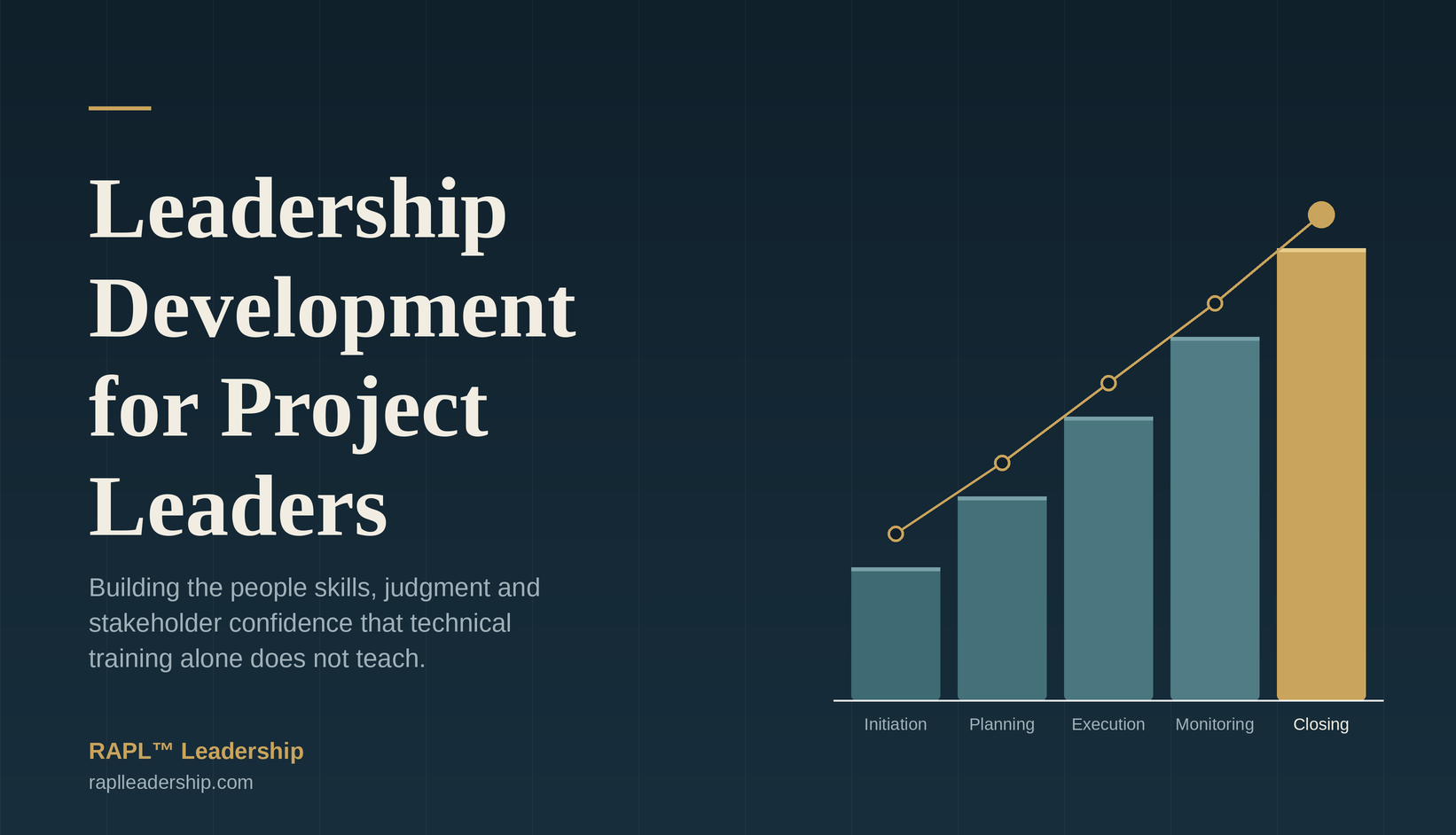
Leadership demands change as a project moves forward.
| Project Stage | Leadership Focus |
|---|---|
| Initiation | Vision, alignment, stakeholder engagement |
| Planning | Collaboration, delegation, communication |
| Execution | Motivation, problem-solving, conflict management |
| Monitoring | Decision-making, risk leadership, accountability |
| Closing | Knowledge transfer, recognition, lessons learned |
During planning, for instance, a leader who invites the team into estimating usually gets more realistic schedules and firmer commitment than one who simply hands down dates. A leader who is strong at execution may still struggle at closing, when recognition and reflection matter more than pace. Effective project leadership is continuous, not something switched on during a crisis. For a wider view of how responsibility moves from defining work to sustaining its value, the RAPL™ framework maps four connected phases.
How Leadership Development Improves Project Team Performance
Strong leadership does not guarantee faster or more successful projects. It can however, contribute to an environment where teams work more effectively. Practical effects often include:
- Greater trust between team members and the leader
- Better communication and collaboration
- Clearer accountability for tasks and decisions
- Conflicts resolved before they affect delivery
- Team members who take ownership rather than wait for instructions
- Steadier motivation during difficult phases
- A culture of feedback and continuous improvement
Ownership, in particular, tends to grow when leaders explain the purpose behind a task and let people decide how to complete it. Each of these strengthens the conditions in which good work happens. None replaces sound planning, but together they make plans easier to carry out.
Leadership Development for Managing Stakeholders
Stakeholders rarely share the same priorities. A finance director watches cost, an operations manager watches disruption and an executive sponsor watches results. Project leaders need to communicate in the terms each group values. A useful habit is mapping each stakeholder's interests and influence early, then revisiting that map as the project evolves, since positions rarely stay fixed.
Trust grows from transparency and consistency. Regular honest updates, including bad news, protect credibility far better than polished reports that hide problems. Difficult conversations, such as pushing back on scope or explaining a delay, require preparation and a respectful tone.
Resistance to change is normal and often carries useful information. Listening to it and using stakeholder feedback to adjust the approach, keeps the project aligned with what the organization actually needs.
How Project Leaders Can Build Their Leadership Capabilities
A practical roadmap looks like this:
- Assess strengths and gaps. Tools such as the RAPL™ alignment diagnostic help compare what a role requires with what current development provides.
- Request structured feedback from colleagues, team members and stakeholders.
- Improve communication and active listening in everyday meetings.
- Practice delegation instead of controlling every task.
- Own difficult decisions and explain the reasoning.
- Learn from successes and failures through honest project reviews.
- Seek mentoring or coaching from someone with broader experience.
- Apply new skills to real projects immediately, because practice is what makes them stick.
Additional leadership development resources can support the reflection that steps two and six require.
Leadership Training and Professional Certifications
Structured training gives project leaders a common vocabulary and tested methods. Useful areas include project management, agile leadership, risk leadership, stakeholder management and strategic project leadership. Credentials such as PMP® or PMI-ACP® demonstrate organized knowledge, and training works best when paired with a live project so new ideas are tested straight away.
Judgment, however comes from experience. Certifications show what a leader knows; leading real teams through real pressure shows how well that knowledge is used. As PMI capabilities increasingly matter to senior decision-makers, project leaders moving toward senior or PMO roles may also consider an executive certificate in project leadership, which is designed for leaders already accountable for strategy execution.
The Future of Leadership for Project Leaders
Several pressures are reshaping the role. AI and new technology require leaders who can guide adoption responsibly a theme covered in why leadership matters more as AI executes more work. Hybrid, remote and global teams demand deliberate communication across time zones and cultures. Cross-functional work is growing, and organizational change is constant.
Behind these trends sits rising complexity, explained in why modern initiatives have outgrown traditional leadership models. Future project leaders will need to combine technical project knowledge, people leadership, business understanding and digital awareness, with adaptability and resilience running through all four.
FAQs
What is leadership development for project leaders?
It is the ongoing process of building the leadership capabilities project work requires, beyond technical methods, through feedback, practice and experience.
What leadership skills should project managers develop?
Communication, emotional intelligence, decision-making, conflict management, delegation, strategic thinking and adaptability.
Why is emotional intelligence important for project leaders?
It helps them read team dynamics, manage tension and build trust, all of which shape how a team behaves under pressure.
How can project leaders improve their leadership skills?
By seeking feedback, practicing delegation, reflecting on outcomes and finding mentors.
Can project management certifications help with leadership development?
Yes, they build structured knowledge, though experience develops leadership judgment.
Conclusion: Leadership Is a Capability That Must Be Developed
Leadership is not limited to a job title. Project leaders influence teams, stakeholders, decisions and the direction of the work itself. That influence grows through learning, practice, feedback and experience, which makes leadership development an ongoing part of a project career rather than a one-time event.
The future project leader will be measured by one standard above the rest: how well they lead people, not just how well they manage projects.