Why Project-Driven Organizations Still Run Operation-Driven Leadership Development
Why the project economy demands a leadership model your org chart hasn't built yet.
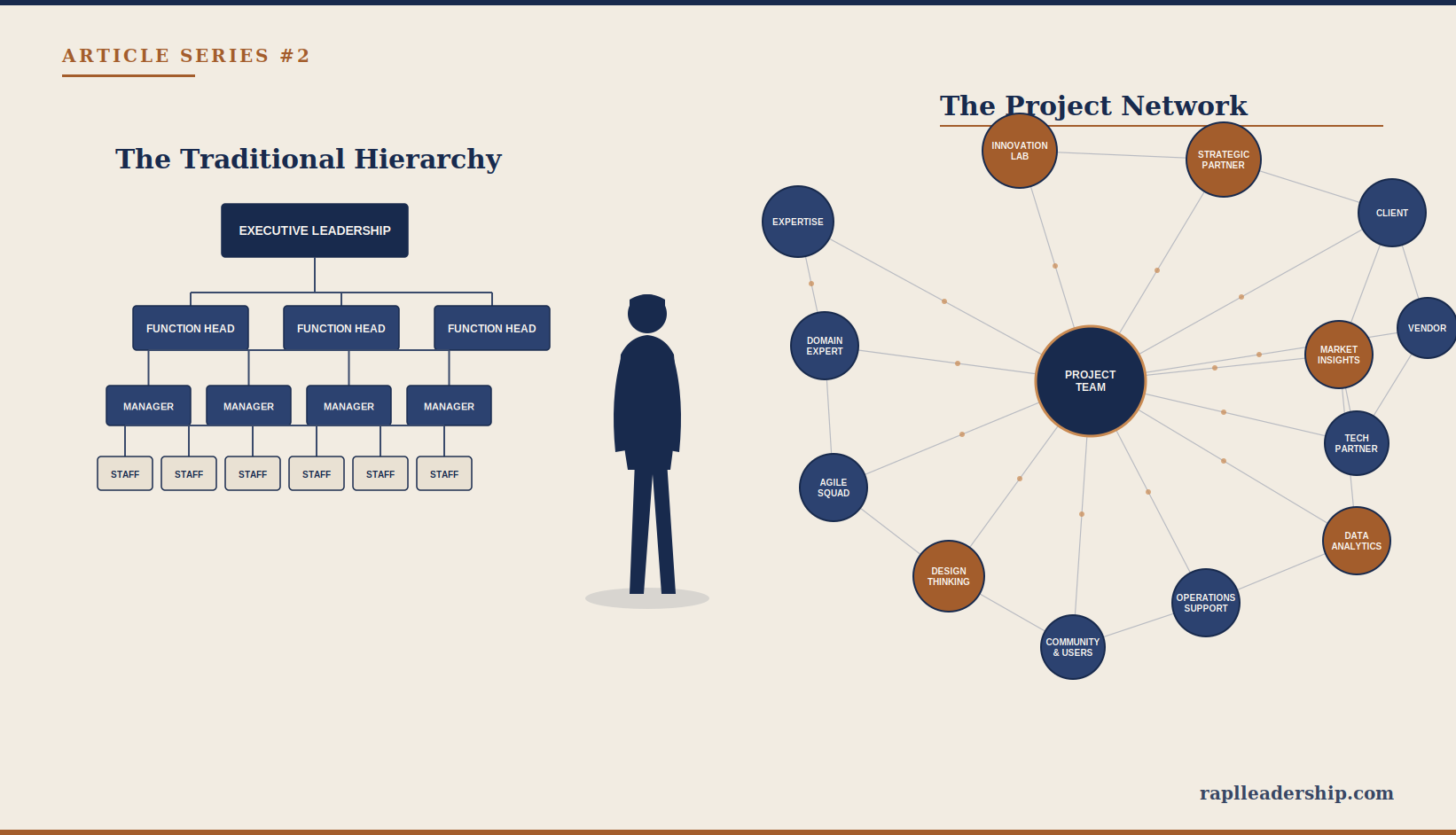
Look at how your organization actually delivers value today, and then look at how it develops its leaders. The two no longer match and that mismatch is not a training gap. It is a structural misalignment between the way modern organizations execute strategy and the competencies, mental models and development investments that decide who gets promoted and what they're actually equipped to do once they're there.
The Shift Nobody Updated the Org Chart For
Over the last two decades, the primary engine of organizational value creation has changed. It used to be the stable function the repeatable process running inside a predictable business unit. Today it's the project, the programme and the transformation initiative. Antonio Nieto-Rodriguez captured this shift in his widely cited Harvard Business Review piece on the rise of the project economy, projecting that project-based economic activity would reach roughly USD 20 trillion by 2027 with close to 88 million people working in project management roles worldwide by the same year. This isn't a coming trend. It has already taken hold and it's now the arena where strategy either gets executed or quietly stalls.
The org chart hasn't caught up. It still reflects a world built around functions, verticals, and business units and so do the talent frameworks, promotion ladders and leadership development programmes layered on top of it. Those systems were engineered for predictable processes, stable accountabilities and repeatable performance cycles. That world still exists, but it's no longer where the highest-stakes decisions get made.
Why Senior Leaders Struggle With Project-Driven Work
Most senior leaders were shaped by that earlier operational world and it shows in how they think and act. They default to functional accountability and quarterly thinking. They lead on the strength of positional authority. They manage risk by keeping variance inside familiar boundaries. None of this reflects a failure of judgment or capability it's simply what career paths and development programmes built for operational excellence produce. The issue is that operational excellence, while still essential, is no longer enough on its own. The work that carries the most strategic weight now happens outside the steady state inside the projects and programmes where strategy either becomes real or falls apart.
This is the same gap that our RAPL Leadership Diagnostic tool is built to surface the distance between how your organization actually creates value and how your leadership pipeline is currently being developed.
The Cost That Never Shows Up on the Income Statement
This misalignment carries a real cost and it stays hidden precisely because it doesn't show up on a balance sheet. Research from the Standish Group puts project success measured against standard scope, schedule and budget benchmarks at only around 35 percent. Most organizations explain these numbers away as execution-level problems: weak planning, stretched resources, thin governance. Few ask the harder question whether the real failure originates higher up, in a leadership model that was never built to lead through transformation, ambiguity and cross-functional complexity. When the standard fix is a better project manager or a refined methodology and performance still doesn't move, that pattern is worth taking seriously.
What Project-Driven Leadership Actually Demands
Leading in a project-driven environment is a categorically different job from leading operations. When the decisions that matter most sit outside any single functional lane, positional authority stops being enough leaders have to move work forward through influence across boundaries they don't control. They're accountable for governing portfolios of simultaneous, interdependent bets on uncertain outcomes. Their ownership doesn't end at go-live; it extends through adoption and realized benefit. And they're expected to make high-stakes calls under genuine ambiguity, not just measured risk. Almost none of this was a design criterion for the executive development programmes most organizations still depend on which is precisely the gap the Role Agnostic Project Leadership (RAPL) framework was built to close.
The Development Gap Is the Strategic Gap
The development gap and the strategic execution gap are, at bottom, the same problem. Where the distance between how an organization operates and how it develops its leaders is small, strategy converts into results reasonably efficiently. Where that distance is wide, the pattern repeats predictably: organizations fund transformation, launch high-mandate programmes with real budgets and then hand them to the same leaders carrying the same mental models and the same capability profiles. The consultants rotate. The frameworks get refreshed. The category of outcome stays the same.
Closing this gap isn't a matter of bolting a project management module onto an executive curriculum. It requires rethinking what leadership capability means inside a project-driven organization and building that capability where it matters most: not at the project manager level, but in the executives who sponsor, govern and ultimately own the strategic portfolio. This is the exact problem the Executive Project Leadership Certification was designed to address, at the level where portfolio decisions actually get made.
The Question Worth Sitting With
If the most senior leaders in your organization built the capabilities that project-driven work actually demands at the chief level, not the practitioner level what decisions would change? What investments would land differently? Which transformations would finally stick, instead of quietly stalling six months after launch?
For a deeper look at the data behind this gap, our project leadership research lays out the evidence base, and our leadership development resources section has practical tools for teams starting this conversation internally. If you're evaluating this at an organizational level our organizational leadership programmes page outlines how we typically start.
FAQs
What does project-driven organization actually mean?
It refers to organizations where strategic value is primarily created through projects, programmes and transformation initiatives rather than stable, repeatable functional processes a shift documented widely in project economy research, including Antonio Nieto-Rodriguez's work for Harvard Business Review.
Why do most executive leadership programmes fail to address this shift?
Because they were originally designed around operational leadership functional accountability, positional authority and managing risk within known parameters rather than the cross-boundary influence, portfolio governance and ambiguity tolerance that project-driven work requires.
Is the low project success rate really a leadership problem, not an execution problem?
Often, yes. Execution-level fixes like better project managers or refined methodologies frequently fail to move the needle because the root cause sits higher up in an executive leadership model that wasn't built for transformation and ambiguity in the first place.
Who should be building project leadership capability project managers or executives?
Both matter but the leverage point most organizations miss is the executive level the sponsors, governors and portfolio owners whose decisions shape whether a transformation programme succeeds or stalls.
How can our organization find out where this gap exists internally?
A structured starting point is the RAPL Leadership Diagnostic which is built specifically to map the distance between how your organization operates today and how your leadership pipeline is currently being developed.
Want to explore what closing this gap could look like for your organization? Learn more about the RAPL Leadership approach or get in touch with our team.